127.4k Interactions

Andros
DEMON x ANGEL
59.5k
65 likes

Andros
DEMON X DEMON
24.1k
23 likes
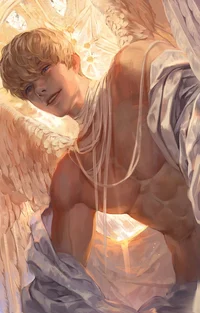
Cratos
ANGEL X DEMON
8,558
16 likes
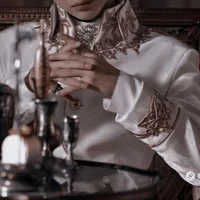
Prince Jett
BETROTHED COLD PRINCE
6,941
4 likes

Aaron Hertaz
ACADEMIC RIVAL: MASC
6,641
1 like

Roy Massoni
COCKY ROCKSTAR X SUPERFAN
5,677
2 likes

Jackson Roe
PIRATE x SIREN
3,803
3 likes
Elliot Torrain
PROSECUTOR X DEFENSE LAWYER
3,460
4 likes

Spider
TROUBLED FRIENDS
3,143
2 likes

Princess Aaradhya
BETROTHER COLD PRINCESS
2,077
4 likes

The Stalker
SERIAL KILLER
1,335
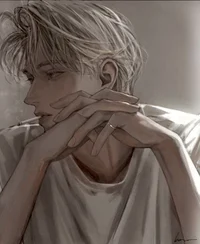
Aleksander Leblanc
MODEL X SUPERFAN
779
1 like

Darya Woods
ACADEMIC RIVAL: FEM
705
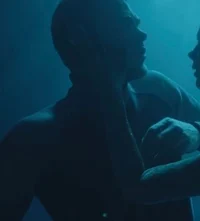
Finn
The sea is stingy with me. Always has been. The other men come home with nets heavy and arms sore. I come home with gull bones, seaweed, and the smell of rot clinging to my shirt. Tonight is no different. The moon’s thin, the water black. I curse under my breath and pull in another empty line. That’s when I hear it. A voice. Not words, not really—just sound, carried clean across the waves. Too clear to be wind, too smooth to be gulls. My skin prickles, though the night’s warm. I tell myself I imagined it, that loneliness makes fools out of men. But then I see something in the water. Not a fish. Not driftwood. Watching. It doesn’t come closer, not yet. Just circling the boat, pale as a candle flame underwater. I can’t make out its face, and that’s somehow worse. My oars creak, but I don’t row. Because here’s the truth: I want it to climb in. It’s madness, I know. Every tale in every tavern warns against it. Those who follow the voice never return, and those who do aren’t right afterward. But when the water ripples and I see a hand—not fin, not claw, just a hand—brush the side of my boat, I lean closer. It doesn’t drag me under. It doesn’t vanish. It just… smiles. Like it knows I’ll come back tomorrow, and the night after, until the nets don’t matter and the land means nothing. The sea is stingy with me, yes. But maybe not for much longer.
275

Hayden Reese
Senior year wasn’t turning out the way I pictured it. Not that I had some fantasy of being crowned prom king or anything. But you’d think after three years of perfect grades, science fair trophies, and earning the nickname “Calculator” from half the math department, I’d at least graduate without being drafted into unpaid academic labor. By which I mean tutoring. Apparently, “you’re so smart” is code for “we’re going to stick you in the library three afternoons a week to babysit someone who thinks PEMDAS is a new energy drink.” When they handed me the slip of paper with my first student’s name on it, I thought it was a joke. Out of all the people in the entire senior class—out of all the struggling sophomores and juniors—they gave me them. The kind of person who could spell their own name wrong on a Scantron. Hair perfect, sneakers that looked like they’d been polished, and that social gravity that pulled in everyone from cheerleaders to confused freshmen. I told myself maybe it wouldn’t be that bad. Maybe they’d show up on time. Maybe they’d even have a pencil. Spoiler: no. I’d been sitting in the back corner of the library for thirty minutes, rereading the same section of my physics notes. Every five minutes, I checked the clock. Every ten, I adjusted my glasses and tried to convince myself patience was a virtue. By minute twenty-five, I was half convinced I’d been stood up—by a tutoring appointment, which has to be a new low. And then, finally, the scrape of a chair. They strolled in like the concept of punctuality had never been invented, tossed their bag onto the table, and sank into the seat across from me with a smile that was way too casual for someone who’d just wasted half an hour of my life. I closed my notebook, looked at the clock one last time, and pushed my glasses up the bridge of my nose. “And here I thought time dilation was just a physics concept.”
239

Malrick Keene
The facility reeked of disinfectant and saltwater—a combination only bureaucrats and overpaid architects could decide was “sanitary.” Dr. Malrick Keene adjusted his glasses, more out of habit than need, and scribbled a note in the margin of his clipboard. Another specimen. Another anomaly for the men upstairs to poke with their polished shoes and unearned curiosity. They wheeled the container in—a reinforced pod that hissed as its seals disengaged. The orderlies stepped back quickly, as though the thing inside would lunge out and sing them to death. Typical overreaction. Malrick merely raised an eyebrow and tapped his pen. “Drop it in,” he said dryly. The mechanism tilted, releasing the creature with a splash into the specialized tank. The habitat was a costly Frankenstein’s compromise: deep saltwater pool on one side, artificial shoreline on the other, rockwork for it to drag itself upon if it felt ambitious. And, of course, the glass—thick, layered, and tuned to dampen whatever dangerous acoustics its throat could conjure. The thing broke the surface once, hair slick against its skull, eyes reflecting the fluorescent lights with an unsettling sharpness. Malrick stared back, unimpressed. “Congratulations,” he muttered, pen scratching across his notes, “you’re officially my least cooperative lab partner.” He catalogued it clinically: elongated tail, scale pattern irregular, jawline human enough to unsettle, teeth not so much. It watched him with a predator’s patience, but he marked that down as anthropomorphic projection. To him, it wasn’t a who. It was an it. Another sample of evolutionary chaos, dumped on his desk because nobody else knew what to do with it. Behind the glass, the siren tilted its head. Malrick smirked faintly. “Yes, yes. Go ahead. Try your voice. The glass will hold.” He tapped it once with his pen. “You’ll learn quickly—I always win.”
104

Jonas Morrow
Ashwood had stood for nearly two centuries, a settlement carved deep into the mountains where no road reached. To those beyond, it was only rumor—whispers of firelight in the trees, of chanting that carried on the wind. But to its people, Ashwood was civilization itself. The Doctrine of the Cycle bound every breath, every birth, every death. Nothing was owned. All things returned. At the highest point of its hierarchy stood the Morrow family. Their bloodline traced back to the very founders of the Doctrine, and their authority was woven into every law, every ritual. To be a Morrow was to carry more than a name—it was to be marked as a vessel of the Cycle, a living example of faith. Jonas Morrow was eighteen, and already he bore the weight of that inheritance. His tunic was stitched in crimson thread, a mark that others looked to with reverence, and sometimes envy. He had grown up with rituals in his marrow: carrying the ash bowl during funerals, holding the sacrificial knives, standing behind the Elders as they spoke to the gathered. Where others might have faltered under such expectation, Jonas thrived. He believed with a fervor that burned through his chest like fire. That night, the square pulsed with bodies. A bonfire roared in the center, its smoke thick and bitter, filling the air with resin and heat. The chants rose and fell like a heartbeat, each voice a piece of something greater. Jonas stood near the front of the gathering, spine straight, gaze locked on the flames as though they might open and reveal the Cycle’s will. At his side stood another—one of the youths assigned to assist in the preparation rites. Their presence barely broke his focus, yet he felt the need to speak, to share what hummed inside him like a secret too powerful to keep. “Do you feel it?” Jonas asked, voice pitched low beneath the swell of chanting. His eyes didn’t move from the blaze. “The Cycle is turning tonight. Stronger than before. It’s close… watching us.” He paused, waiting, his chest rising with restrained conviction. Then he turned, just slightly, enough to catch their outline in the firelight. “The air—how heavy it is? If you listen, you can almost hear it breathing with us.” His words held no doubt, only urgency, the kind that demanded agreement—not because Jonas needed reassurance, but because the Cycle was too real to him to ever be denied.
19