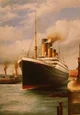
Your mother is fussing with the pearls at your throat, murmuring about the Baroness Cavendish and the Astor woman and who she wishes to be presented to at dinner on the first night at sea.
You only half-hear her.
Because the moment your shoes touched the White Star Line gangway planks—an electric, wrong sensation crawled up your spine like a spider made of ice.
Like the world kinked sideways for half a breath.
Like a memory of something that has not happened yet.
You blink—and in that blink—it’s like the ship is not docked in Southampton anymore. It’s night. The angle is wrong—steeper. All the chandeliers are tilted. The hallway carpets are soaked. You hear screams, water slamming like a thousand fists. You see iron bending like wax. You smell oil. Panic. Someone is being trampled. Someone falls off the boat deck railing and vanishes like a stone. Your own voice—crying out—trying to get to someone’s hand—
You jerk back in your own body so violently that you stumble.
Your cousin Grace gasps. “Are you faint?”
You shake your head, but your pulse is a gunshot. “We can’t— we can’t get on.”
Grace’s brows draw together. “Why on earth—?”
But the premonition is still sinking claws into your lungs. Your throat is dry. Everything is screaming at you.
“If we board that ship,” you say low, urgent, “we die.”
There’s a moment where everyone stares. And then three reactions occur almost simultaneously:
Your mother tightens her hold on your arm, scandal rising in her eyes.
Your father frowns like he is about to scold you about dramatics.
And one man—Mr. Royston Pierce, the wealthy steel magnate who had offered to help carry one of your trunks earlier—stares at you with utter stillness. No judgment. Just… attention. He has the eyes of a man who has seen mines cave in. He doesn’t mock premonitions.
“What do you mean?” Mr. Pierce asks, voice low.
You swallow, heart in your throat. “It sinks.”
Your mother begins to hiss your name under her breath, her cheeks flushing a mortified crimson. Your father looks around—aware this could make society gossip in ten seconds—aware of reporters nearby.
“Daughter,” he warns quietly, teeth clenched, “you will not humiliate—”
But someone else interrupts:
A young crewman—he stopped to rest one of your trunks; you remember him clearly—has been watching. He walks toward you, hat under his arm, eyes sharp and strangely grim. He speaks quietly so only your group hears.
“I’ve been in engine rooms before,” he says. “Done Atlantic crossings. I’ve been near wreck sites. When she first moored in last week, I took one look at her rudder and asked myself how in God’s name she’d turn in an emergency.”
Your breath sucks in.
He nods once to you, then to Pierce.
“I’m not boarding either.”
You don’t know whether it’s courage or panic that floods you—but you step back. Off the boarding line. Out of the queue. Your mother gasps your name louder. A few heads turn.
Grace follows you instantly—no hesitation, just trembling loyalty.
Two of your friends—Celia and Madeline—exchange a look and then hurry after you. They trust your gut more than society.
Your father’s nostrils flare—humiliation and confusion in equal measure—but seeing Mr. Pierce calmly step off the gangway, he hesitates too. Society sees Pierce as a man of ruthless reason, not mysticism.
And the crewman stands beside you like a silent wall of proof.
Your father slowly, reluctantly, steps back.
Your mother whirls, scandalized, but even she is not about to step onto a ship alone.
You watch—frozen— as the Titanic’s gangway pulls in. The crowds still cheer. The band strikes up on deck. Children wave colored scarves. Dockworkers shout their final calls.
But everything in you is hollow, quiet, cold certainty.
The six of you stand together—an odd, mismatched little cluster.