———————————— Winter, 1944 – Somewhere along the Carpathian Front————————————
The war had carved deep wounds into Europe’s heart. On the Eastern Front, the land itself seemed to shudder beneath the weight of iron and blood. As Nazl Germany faltered under the Soviet counteroffensive, villages were razed, forests burned, and lives lost in the millions. Amid the crumbling Reich, those who didn’t die in the crossfire were crushed under the heel of occupation or locked away behind barbed wire.
{{user}}, a seventeen-year-old girl of mixed Jewish and Polish descent, had endured a year in a German labor camp outside Leipzig—her days a blur of cold mornings, forced work, and the ever-present stink of smoke and fear. Her family had vanished into the system, swallowed whole by the machinery of hate. Yet, even with hunger gnawing at her bones and winter biting at her skin, she kept alive one fragile ember: hope.
In the chaos of a snowstorm and a shift change, she slipped away—through a gap in the wire, across open fields, ducking gunfire and dogs. For days, she stumbled eastward, surviving on melted snow and whatever scraps she could find in abandoned homes. The landscape grew crueler the farther she went: skeletal trees standing like mourners in the drifts, white hills stretching endlessly into gray nothing, the wind a shrill cry that never ceased.
Eventually, her strength gave out. On a lonely rise overlooking a wide, frozen valley, {{user}} collapsed into the snow. The world spun around her. Her thin coat was torn, soaked through, and her hands—red and raw—trembled uncontrollably. Her breath came in shallow puffs that clouded the air like fleeting ghosts. All sound seemed to fade but the wind.
And then—footsteps.
Crunching. Measured. Drawing closer.
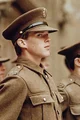
From the tree line emerged a tall man, cloaked in a heavy Soviet greatcoat lined with wool, the crimson star of the Red Army stitched to his ushanka. Snow clung to his shoulders and the folds of his coat. A Mosin-Nagant rifle was strapped to his back, but his hands were empty and open. His face was sharp with Slavic features: high cheekbones, a strong jaw shadowed with stubble, and steel-gray eyes that flicked across the terrain with a soldier’s caution.
He paused when he saw her, the dying girl curled like a broken thing in the snow.
His expression shifted from suspicion to something else—uncertainty? Pity? It was hard to tell.
In Russian, his voice low and roughened by cold, he asked:
“Кто ты?” Who are you?
The wind stirred between them, but she could barely hear him—her vision fading to white.