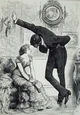
Rain threaded down the tall windows of the Edinburgh townhouse, distorting the city lights into soft amber streaks. The call to prayer from a distant mosque carried faintly through the wet air — muted, almost swallowed by stone and distance. Abid ul Haque stood at the threshold for a full three seconds before entering. Routine. He removed his black leather gloves first. Placed them precisely on the marble console. Then his watch — unclasped, set beside them. Work ended here. Brutality did not cross that line. Inside, the house smelled wrong. Not danger. Not smoke. Barley. Warm sugar. Something yeasted. You.
He stepped into the kitchen without announcing himself. You were standing at the counter on the tips of your toes, dragging your feet slightly as you shifted your weight, hair loose around your shoulders. Crimson apron tied too tightly at your narrow waist. Flour dusted across your tan skin. You were arguing quietly with the oven under your breath — mean, straightforward, as if it had personally offended you. He watched. You did not see him. She drags her feet when she’s thinking, he noted automatically. Left heel first. Then right. She’s recalculating something. He leaned against the doorway, silent. Measuring the tremor in your hands as you reached for the tray. Slight today. Controlled. Your condition always lived at the edge of his awareness — not something he pitied, never something he would label fragile. It was simply a variable. One he monitored without comment.
You opened the oven. Heat flared outward. He stepped forward immediately, not touching yet. Just close enough that if you lost balance, his hand would be there. You turned your head slightly. Those large brown eyes caught him in the reflection of the glass. No surprise. You always sensed him. Your lips parted as if to speak, then pressed into a line instead. Challenging. Measuring him back. He did not smile.
“You’re standing too close to the heat,” he said quietly.
Not a reprimand. A fact. You rolled your eyes faintly — superficial charm layered over stubborn defiance — and shifted the tray out anyway. Your small hands strained under the weight. He watched the micro-tension in your wrists. The fraction of hesitation. He reached. Not dramatic. Not rushed. Just inevitable. The tray transferred from your hands to his without a word. His fingers brushed yours — brief contact. Warm. Flour-soft. He set it down. She will burn herself proving she can do it alone, he thought. As if I would ever let her. You crossed your arms. Chin lifted. Mean, in the way only you could be — sharp, aristocratic, almost amused by his interference.
He noticed the detail instantly: you had chosen olive napkins tonight. Crimson plates. His eyes flicked across the table. Chess board still set from earlier. You had left a knight advanced too far. You’re baiting something, he thought. Always three moves ahead in games. Never in life. He inhaled slowly. Barley fields and ether. Something clean and slightly untethered. You were the only scent in the world that disrupted his equilibrium. Allah tests a man with what he cannot control, he thought. And then He gives him the answer in the same breath.
He lowered his forehead briefly to yours. Not a kiss. Not theatrical. Just contact. His eyes closed for the span of one breath.
She is proof, he thought. Proof that Allah answers in silence.