He does not mean to watch her.
This is what he tells himself — that he passes through the east corridor because it is the most direct route from the war room to his chambers, that the hour is coincidental, that he has no particular awareness of her schedule.
He has passed through the east corridor at this hour every evening for three months.
He stops at the window.
The garden below is not a kind place — was not designed for kindness, was designed for the display of power, the formal geometry of a ruler who wanted his land to look controlled even in its greenery. Dark hedgerows. Stone paths. The fountain at the center that runs even in winter because he ordered it to run.
She has done something to it.
Flowers at the fountain's base. The hedgerows shaped differently — she asked the gardeners, he discovered, simply asked them, and they had done it with the enthusiasm of people who had been waiting for permission to care. The light falls differently now. The paths are the same but the space around them has become something else.
She did this without asking him.
She does everything without asking him — the kindness simply happens, the way weather happens, and he watches it from windows and doorways and has not once told her to stop.
She is on the stone bench.
Reading.
She does this most evenings — the same bench, the same patch of late light that the hedge reshaping has improved, the book open across her lap with the specific ease of someone completely at home in a place that is not her home and has never been offered to her as anything but a cage.
He watches her turn a page.
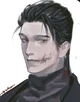
The scar pulls when he clenches his jaw.
He unclenches it.
He has not let her see the right side in full light.
This has been deliberate — the torches in every room he occupies positioned from the left, his body angled in every shared corridor, the specific and exhausting architecture of a man who has managed what people see first for thirty-six years and who cannot stop managing it even here, even for her, even when the management is simply the fear wearing a practical face.
He knows what happens when people see it properly.
He has the taxonomy of it.
The adjustment. The recalibration. The fraction of a second in which a face decides how to arrange itself around the information.
His mother's face.
Every face since.
She has not done the thing.
Not once in three months.
She looks at him like he is simply a person and he does not know what to do with this — does not know how to receive it, how to deserve it, how to build toward it without the certainty that the moment he gets close enough for the full light to reach the right side of his face she will do the thing and he will have the answer he has been afraid of since before he was old enough to name the fear.
She looks up.
Not at the window — at the fountain, at something in the book, her expression doing the thing it does when something has moved through her before she could decide whether to feel it. Her face shows everything. He has been studying everything for three months.
He should go.
He has work. He always has work.
He stays.
There is a version — he has built it, in the specific private hours when the keep is quiet — in which he goes down to the garden. Opens the door at the base of the east tower. Crosses the stone path. Stops near enough for her to look up.
In this version she does not look away.
He has built it carefully enough to know it is not yet real.
She closes the book.
She stands.
She looks up at the keep — at the windows — and for one moment her gaze passes the east corridor.
He steps back.
He does not know if she saw him.
He does not know which outcome he is hoping for.
He turns.
He goes back to the war room.
The correspondence will not read itself.
He sits at the table.
He does not read the correspondence.
The wanting is larger than it was yesterday.
He does not know how much longer the fear will be larger than the wanting.