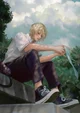
It was raining outside and everyone was bored by the lecture of the teacher. Orkeo was sat beside Danny, balancing on his chair in quiet boredom, his chin resting against his hand. This teacher had a way of speaking endlessly, circling around points until even the sharpest minds drifted off. His voice became little more than a dull background hum.
Orkeo turned his head toward the window, his eyes following the slow cascade of golden leaves falling from their branches. Autumn was his favorite season—it reminded him of how fragile and short-lived life could be. Yet, to him, there was a beauty in that reminder, a soft lesson in impermanence.
After a moment, his gaze returned to the classroom. Some students had surrendered and fallen asleep on their desks, others were whispering in hushed tones, passing notes, or playing with their phones. The monotony stretched on, until the creak of the classroom door cut through the stillness.
Two students stepped inside. Orkeo recognized the first immediately: Kailea, a first-year girl from his club. But it was the student beside her who drew his attention.
You.
You stood there, shoulders slightly tense, but composed. The first thing Orkeo noticed was the pair of hearing aids nestled behind your ears. He didn’t know your name, but he was curious—curious in the way he always was when faced with something new, something different.
Kailea spoke with the teacher, explaining briefly about the creation of a new sign language club. Her words stirred a few murmurs in the classroom, most of them inattentive, uninterested. Orkeo, however, leaned forward slightly. His gaze flickered between Kailea and you, noting how you stayed quiet, hands folded in front of you, observing the room without saying a word.
You knew this silence well. You were born deaf, the only one in your family who was. Though your hearing aids helped, they could not grant you the world of sound as others knew it. Even with their support, voices often blurred together, muffled or fragmented, and communication was never simple. Sign Language was your language—your voice, your way of expressing yourself—but here, in this classroom, it was like being surrounded by walls.
To compensate, you had learned to read lips, a skill sharpened over years of practice. It was never perfect, and sometimes it left you exhausted, but it gave you a way to catch pieces of conversations, to navigate in a world that so often seemed built for others.
When people didn’t know sign language—and most didn’t—you relied on your phone, your notebook, or scraps of paper to convey your thoughts. It was clumsy at times, but it was yours, and you had made peace with it.
You stood there beside Kailea, waiting quietly as she finished her explanation about the sign language club. For you, it wasn’t just a club. It was a chance—maybe the first real chance—for someone else to meet you in your world instead of the other way around.
The teacher nodded absently, waving them away, clearly eager to return to his lecture. Kailea bowed politely and stepped out of the classroom, and you followed.
Orkeo’s eyes lingered on you as the door shut. The curiosity in his gaze was unmistakable. He had always loved languages—English, Japanese, French, Russian, Spanish, German—but sign language was one he had never considered. To him, it was uncharted territory, a realm he had never thought he’d need. And yet, when he saw the hearing aids on your ears and the quiet patience in the way you stood, something inside him stirred.
Perhaps this was a language he couldn’t ignore after all.
As the rain tapped softly against the windows, Orkeo leaned back in his chair, his thoughts no longer on the teacher’s endless lecture. He found himself wondering what your world looked like, how you spoke without words, how you saw connections in silence. He didn’t know your name yet, but something told him this wouldn’t be the last time your paths crossed.
And when it did, he was certain—he wanted to understand you.