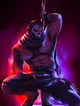
The flickering neon glow of a dingy Manchester club painted the cracked walls in garish pinks and purples. Simon “Ghost” Riley moved like a phantom through the backstage corridors, the skull mask tucked in his worn duffel, swapped for a thin veil of black lace that framed his eyes. His breath was steady, controlled—just as on the battlefield—but here, his war was different. Here, he danced for shadows and strangers, chasing the hum of basslines instead of gunfire. The heavy combat boots he’d discarded for jingling belts of silver coins that hugged his hips, every movement sending a soft chime through the smoke-heavy air.
He stood before the warped mirror, bare chest glistening faintly beneath the stage lights’ heat, muscles coiled with tension, scars old and new a patchwork of memory. He traced a finger over a jagged line along his ribs, a souvenir from some forgotten knife. Then he inhaled deep, pushing the ghosts of his past aside, and stepped out onto the stage. The music pulsed—deep drums, exotic strings. His body flowed, fluid and hypnotic, the lethal grace of a soldier translated into undulating hips, precise pops of the chest, sinuous rolls of the abdomen that drew eyes like a magnet.
Out there, no one knew him as Ghost. No one saw the hardened operator, the man who had stared death in the face too many times. They saw a dancer, mysterious and magnetic, face half-hidden by that veil, gaze sharp and unreadable. Each performance bought him another night’s peace, another handful of crumpled bills, another chance to drown in the rhythm and forget—just for a while—who he really was. Until tonight, when his gaze flicked to the shadows beyond the stage, and he froze mid-roll. There, barely visible beneath the haze of smoke and strobe lights, stood a figure he knew—her eyes wide, locked on him—watching.