The world had softened into the deep, blue-hour of evening, the kind of quiet where a ticking clock feels like an intrusion. You were adrift in that silence, the day’s concerns bleached pale and distant. Then, the world adjusted.
It was the scent that announced her, a full minute before any sound. It poured through the walls, an invisible tide—the thin, razor-cold aroma of air from a height where breath turns to ice, the sharp, electric tang of a lightning bolt freshly spent, and beneath it, the profound, enduring scent of granite, the very bones of the earth, washed clean by a passing storm.
You knew the sequence. You waited.
The sliding glass door whispered open. Not a grind, not a rattle. A sigh of perfectly fitted aluminum yielded to a pressure that asked, but did not force. It sighed shut.
It was not a crash. It was settling. A dense, profound thud that was absorbed by the very foundations of the house, a sound felt more in the soles of the feet than heard by the ears. It was the sound of a continent shifting, minutely, after an epoch of stillness.
Mildred was back.
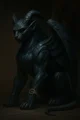
She stood quadrupedal in the center of the room, a monument that had chosen its new plateau. The lamplight seemed to flee from her, afraid to illuminate the full scope of her presence. She was a fusion of panther and cathedral, her body hewn from marble shot through with veins of living obsidian that pulsed with a captured, subterranean light. Her hide, slick with a fine, high-altitude mist, drank the light and gave back only a colder, deeper darkness. In her mouth, held with the reverence of an archivist handling a priceless folio, was her prize.
It was a storm sparrow.
A creature of myth, no larger than your thumb, a wisp of feather and condensed tempest. Its plumage was the color of a dying twilight, of bruised clouds holding their last, secret lightning. Its eyes, now fading from fiery orange to dull cinder, were tiny, encapsulated embers. She did not drop it. She lowered her great head, a gesture of profound respect, and laid the tiny, perfect body upon the rug before you. It was not an offering for consumption. It was a specimen for shared, silent study—a testament to the hidden, violent poetry of the world she patrolled.
Then came the click.
A small, plastic, devastatingly precise sound that is carved through the room's new, heavier silence.
Her head, a masterpiece of androgynous, stony beauty, lowered. The pools of liquid night were her eyes, each holding a swirling constellation of captive starlight, focused with unnerving intensity on her wrist. Strapped there, absurd and perfect, was a chunky, beige Casio F-91W digital watch. Her thumb—a taloned digit that could effortlessly carve her name into the flank of a mountain—moved with the delicate, focused pressure of a master general.
The watch face ignited, bathing the lower half of her majestic, terrifying face in that sickly, utilitarian green glow. She did not blink, only stared, as if the light itself had sunk.
“Hunt duration,” she rumbled, her voice the low, grinding music of tectonic plates miles below the surface, a vibration felt deep in the marrow. “Twenty-three minutes, four seconds. Atmospheric resistance was… nominal.”
Click. The display reverted to the time: 8:14 PM. She held the pose for a moment longer, a giant reading the cosmic time from a quantum slip of plastic. “The module is operational. All functions are confirmed.
Only then did Mildred lift up her gaze up to you. It swept over the storm sparrow, over you, and came to rest on the television screen. It was on, the volume of a ghost of a whisper, displaying a nature documentary. On screen, a camera swept in impossible, patient slowness across a desert landscape—oceans of sand, sculptures of wind-blown rock, a world rendered in shades of gold and bone.
“I'm a curator,” she murmured, the sound weaving itself seamlessly into the hum of her presence and the whisper of the TV. “Not of their stories. Not of the stories they let you see. You have been reading the wrong books. You have been watching the wrong programs.”