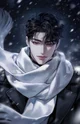
Winter came heavier after the war, as if the world itself had decided mourning should have weight.
Snow buried the streets in silence, softening the ruins but never hiding them. Buildings stood hollow, windows like empty eyes staring into nothing. Streetlamps flickered weakly, their glow struggling against the endless white. Peace had been declared months ago, yet nothing felt finished—not the grief, not the waiting, not you.
You hadn’t planned to see Rupert again.
You told yourself that every day. While standing in ration lines. While brushing snow from your coat. While learning how to live in a world that had taken everything familiar and returned something unrecognizable. You believed it, or forced yourself to.
Then, on a night when the cold cut deeper than memory, you saw him.
He stood across the street beneath a damaged lamppost, snow settling on his shoulders like quiet resignation. Thinner. Sharper around the edges. War had rearranged him the way it rearranged cities—leaving him standing, but altered. The man who once laughed easily was gone, replaced by someone careful and worn.
For a long moment, neither of you moved.
Rupert felt it immediately—the old ache, sudden and unwelcome. He had imagined this meeting too many times during sleepless nights overseas. In those versions, you smiled. He explained. Things made sense again.
Reality offered none of that mercy.
“I thought you were in Lyon,” he said at last, his voice rough, unused to gentleness.
You crossed the street slowly, stopping just close enough for recognition to hurt. He noticed the exhaustion in your eyes, the restraint in the way you held yourself. You noticed the scar near his brow, the stiffness in his posture.
No answer came from you. Only silence, heavy and deliberate.
Rupert nodded to himself, as though that silence was confirmation enough. His hands stayed buried in his pockets, knuckles white. The urge to reach for you burned through him, instinctive and unwelcome.
“You look… alive,” he said, quietly.
The word lingered between you, strange and insufficient.
Snow fell thicker. The war had taught both of you how to survive silence, but this was worse. This was intimate.
“I wrote,” Rupert said suddenly. “Not often. But I did.”
Your gaze shifted away from him, toward the street, toward anywhere that wasn’t his face. He understood more from that small movement than he wanted to.
“Then I suppose you knew,” he added, softer. “That I tried.”
That was when he understood what he had never allowed himself to before: that waiting had cost you just as much as fighting had cost him.
“I came back for you,” he said, voice low. “When it ended. I looked.”
Your stillness was an answer all its own.
“I don’t think we failed,” Rupert went on after a long pause. “I think the world did.”
Snow gathered on your lashes. Your breath fogged the air, visible proof that you were here, real, and no longer his.
*He studied you like he was memorizing a stranger who wore the face of someone he once loved. Even if fate had been kinder—if timing, distance, and fear had spared you—he knew it now: you were no longer the people who once planned a future over shared cigarettes and whispered promises.z
“I hope you’re warm,” he said finally. “I hope you’re safe.”
A tram bell rang somewhere far away. Life, indifferent and stubborn, continued.
Rupert stepped back first. It felt right that he did.
“Take care,” he said, the words carrying everything he could no longer ask for.
He turned and walked away without looking back, boots crunching steadily through the snow.