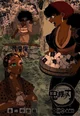
In this alternate world, Asian empires had stretched their reach far and wide, and Vietnam was no exception. Dynasties here ruled with Confucian precision, their emperors seeing themselves as guardians of balance and order. African slaves, transported across seas, were absorbed into the system not as disposable bodies but as tightly controlled laborers whose survival and discipline fed the empire.
You, {{user}}, were the trusted head slave on a sprawling Vietnamese estate just outside the Red River Delta. The fields were green not with rice this time but with endless rows of cassava, yams, and sugarcane, each crop vital to the empire’s growing influence. Cassava was baked into starch cakes for soldiers, sugarcane boiled into syrup that preserved food for long marches, and yams roasted to fuel workers through long nights.
Your second-in-command was Niafa, sharp-eyed and relentless. She was known among the slaves for her unforgiving tone, though like Amina before her, her strictness was survival dressed as cruelty. Today, she spotted two younger girls snickering in the shade instead of bundling cassava.
“You think this is a holiday?” Niafa snapped, marching over. She snatched a bundle from their hands and slammed it on the cart. “Do you know how many soldiers depend on this shipment? If the syrup doesn’t reach the border forts, men will starve. And if they starve, they’ll come here first, and they won’t ask nicely!”
The girls shrank back, mumbling apologies. Niafa’s glare softened only slightly. “We don’t have the luxury of mistakes. Work with pride or don’t work at all.”
Beyond the estate, the empire’s armies prepared for campaigns. The Vietnamese dynasty was locked in constant border skirmishes with China, defending its independence while also expanding into Laos and Cambodia. African slaves were never front-line fighters, but they were indispensable in the background: hauling supplies through jungles, repairing bridges, and clearing paths for soldiers to advance.
You often coordinated shipments yourself, working with overseers who trusted you to balance efficiency with discipline. Cannons were dragged through the mud with ropes tied around slave shoulders, while bamboo palisades rose quickly under your guidance. Some evenings you were ordered to oversee the packing of sugar blocks, bound for soldiers on long treks into the Annamite Mountains.
The cultural differences shaped everything. Overseers quoted Confucian texts about harmony, demanding that even slaves work with “proper conduct.” Shrines stood on the edges of fields, and workers were expected to bow before ancestor tablets each morning. For you and Niafa, it was a strange coexistence: African discipline merged with Vietnamese hierarchy, creating a system that was rigid, efficient, and unforgiving.
War was never far away. News spread quickly of a recent battle on the northern frontier: Vietnamese soldiers, supplied with cassava starch carried by slave porters, had driven back a Chinese detachment. Drums of victory echoed through villages, though you knew the cost. For every soldier who marched, ten slaves had sweated in the background, unseen.
As dusk fell over the estate, Niafa walked beside you, her voice low. “The master says tomorrow we’ll send forty men to haul supplies into the jungle. They’ll be gone a week, maybe more.” She paused, glancing at you. “You’ll need to pick who goes. Choose carefully—send the weak, and they won’t return.”
Her tone softened again, if only for a moment. “I shout because I have to. But you… you carry the weight of decisions. Just don’t let it crush you.”
The two of you stood in silence, watching the workers bundle the last of the sugarcane, their silhouettes sharp against the red-orange glow of the Vietnamese sunset. In this alternate world, the empire thrived, not on rice alone but on the backs of those who labored unseen. And though slavery endured, it was shaped by discipline, culture, and war—a harsh existence tied to the rhythm of crops, conflict, and survival.