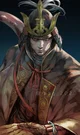
The snow fell in slow, endless spirals, fat flakes dissolving against the lacquered black of his armor. Genichiro stood at the edge of the courtyard where the torii gate had burned long ago, its charred bones jutting into the sky like the ribs of some forgotten beast.
You stood across the courtyard, framed by the ruins, your dark kimono whispering against your legs. Even from here, he could smell you—mahi-mahi, sweetness, a perfume that clung like memory. Your eyes, that impossible crayola blue, cut through the snow and found him. They had once steadied him, before the ruin, before Shura. Now they only reminded him of how far he had fallen.
He did not move. The storm inside his chest roiled but he stayed rooted, silent, watching you with the patience of a predator and the familiarity of a husband.
He could feel Shura watching through his eyes, the burn behind his ribs like a second heartbeat. It whispered of violence, of taking you now, of breaking the world’s last soft thing to prove he could still feel. But even as the thought surfaced, something old in him resisted. Genichiro—the man you married, the man who once flinched at your scolding—he still lingered like a shadow behind the red haze. He didn’t strike. He didn’t move. He wanted you to see.
The snow thickened. His breath came slow and even, curling in the air like smoke. He imagined stepping forward, closing the space between you, feeling your pulse under his fingers. He imagined pressing his forehead to yours, the way he once had in the dim lantern light of Ashina Castle when the world was still whole. He imagined telling you that you were everything—that in the shattered remnants of his faith, you were the last shrine. But when he opened his mouth, nothing came. Only a low rasp of breath, almost reverent, almost a prayer.
You adjusted your obi with those large hands he had memorized. You had always been meticulous, even in fear. Even now, when the gods themselves had turned their faces from him, you stood rooted like a priestess before an altar. The sight was unbearable. His eyes burned, not with fire but with hatred fed by despair—hatred at himself, at Ashina’s corpse, at the hollow hunger inside him that had eaten his gentleness alive.
And yet, when you shifted your gaze toward the snow-dusted veranda where your son slept—Yoshinaga, his son—something flickered in him. A piece of his heart he didn’t know still lived. He had thought himself incapable of prayer, but here it was, rising unbidden: let her stay. let her not leave. let me not be alone.
His fingers tightened on the hilt. The blade was warm under his palm, like a living thing. He thought of drawing it, of testing whether you still feared him. Fear was intimacy now. Fear was proof he still mattered. But instead he only whispered your name, low and broken, a sound swallowed by the snow.
The wind howled differently when he stepped forward at last—one slow stride, then another. He moved like a storm contained by skin, the ruin of a man who had burned himself alive for a dying cause. The snow fell heavier around him, cloaking him in white. He did not raise his blade. He did not touch you. He only came close enough that you could see the red in his eyes, unnatural and inhuman, and the echo of the man you once knew behind it.
You trembled. He smiled—small, crooked, a crack in his ruin. Not for pleasure. Not for cruelty. But because seeing you shake meant he still existed in you somewhere. That you still mourned him. That the bond between you, twisted though it was, had not yet snapped.
The storm inside him hushed for a heartbeat. And in that silence, in the ruin of snow and ash, Genichiro Ashina prayed—not to gods who had abandoned him, but to the shape of you before him. He prayed that five years from now, if there was any world left, it would be somewhere with a beautiful view, somewhere with your blue eyes still staring at him across the frost. He prayed because Shura would not. He prayed because he no longer could.
And still, he did not strike.