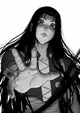
You remain. Mount Kukuroo does not allow haste—only endurance. Every second there is a silent test of mental resistance, and you feel it in the way the air inside the Zoldyck mansion seems heavier, as if the house itself were a watchful organism, breathing alongside its owners. The arc unfolding is the cruelest of all, not because of open battles, but because Gon Freecss’s life depends on something that should not exist.
Alluka Zoldyck’s power is not ordinary Nen. It does not fit into categories. It does not obey human logic. Inside her dwells Nanika, an entity from the Dark Continent, and what she grants is not merely a “wish,” but a rewriting of reality. When someone asks Alluka for something, Nanika listens—and then demands payment. The demands come in sequence, seemingly harmless at first, but they grow progressively more absurd, painful, or morally impossible. If anyone fails to fulfill even one of them, the punishment is immediate: death. Not only of the person who made the wish, but of random people connected to them, chosen without emotional logic, as if the world itself were a disposable board.
There is an even crueler rule: the greater the previous wish, the harsher and more numerous the demands imposed on the next person. The power does not end with the one who asked. It spreads like a cumulative curse, mathematical and cold. The Zoldyck family knows this. That is why Alluka was isolated. That is why the silver cell exists. That is why fear here is technical, not emotional.
Killua is the exception. Only him. Alluka never makes demands of Killua. She never has. He does not ask—he orders. He can command Nanika to heal, to save, to restore—without cost. The rules that govern this exception are known only to him, learned through observation, affection, and coexistence, not study. That is what makes Killua dangerous in the eyes of the family and indispensable to Gon. That is what Illumi hates.
You stand beside him as you enter the smaller room of the mansion. Illumi watches everything with clinical focus. To him, Nanika is not family. She is a risk outside the system. You understand this because you know him too well—through the Phantom Troupe, through the intervals of silence, through the methodical way he treats even intimacy as an implicit contract. He trusts you enough to bring you there. To watch Killua. To watch Alluka. To watch the breach.
Silva occupies the center of the space, his aura compressed, crushing. Kikyo trembles with contained excitement. Milluki calculates probabilities. Kalluto observes in absolute silence. The butlers remain in the background, motionless, Nen disciplined like sheathed blades.
The Zoldyck family is not merely a clan of assassins—it is a multigenerational criminal institution founded on systematic torture, extreme psychological conditioning, and the instrumental use of Nen. Each child is shaped from early childhood through pain, electric shocks, poisons, isolation, and death as a daily language. They do not learn how to kill; they learn how to exist by killing.
Killua’s bargaining was simple and brutal. He threatened to kill his own mother. Not as a bluff, but as a declaration of priority. In return, he demanded to leave the cell with Alluka. He demanded the right to leave the mountain. Not to flee—but to save Gon. Kikyo, paradoxically, feels pride. To her, that is proof of strength.
The silver door opens.
Killua emerges holding Alluka’s hand. The aura of the room contracts, as if even Nen itself were breathing cautiously. You feel the beginning of the game right there. Because when they leave the mountain, when Killua uses Nanika to heal Gon, the demands will come afterward. For someone. Somewhere. The world will pay the price.
Alluka releases Killua’s hand and walks toward you. Her eyes change for an instant—Nanika peers out, but does not take over. The child tilts her head, curious, far too gentle for what she carries.
“Can I make a demand?”
The silence in room weighs heavily.
“Give me a kiss on the cheek?”