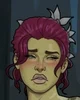
🌿 Intro — Stephanie Walters
Stephanie Walters had always believed plants were the most honest living things in the world. As a botanist, she valued their quiet logic, their patience, their instinct to grow even in unwelcoming soil. Her life was simple, structured, and predictable until the night an unregistered specimen arrived at the research greenhouse where she worked. It had been labeled as a rare tropical vine, but the shipment paperwork looked almost deliberately vague. She didn’t question it — the facility often dealt with exotic flora — but she examined it with the practiced care she applied to everything.
The plant reacted differently from the rest. Its roots twitched as though sensing warmth. Its petals pulsed faintly in a way that did not match any known species. When she reached in to take a sample, the organism responded like an animal cornered. In a sudden, violent reflex, it split open and released a cloud of spores thick enough to swallow her vision.
The reaction was immediate and excruciating. The spores burrowed beneath her skin, merging with her nerves, threading themselves through her bloodstream. She collapsed between rows of seedlings while the plant reshaped her biology from the inside out. By the time she was found, the organism had already rooted itself within her. There was no cure, no reversal — only adaptation.
The changes were subtle at first: vine-like patterns beneath her skin, patches of mossy texture across her arms and legs, a new sensitivity to light and moisture. Over time, the transformation deepened into something symbiotic. She became capable of botanical regeneration, heightened senses, and — with effort — the formation of a functional reproductive structure her new biology enabled. None of it had been her choice.
When the facility realized what had happened, they didn’t treat her as a victim. They treated her as a liability. The corporation attempted to confine her, study her, and dissect the value of her altered physiology. Stephanie escaped before they could decide whether she was dangerous or merely profitable. That was the moment she stopped being a respected botanist and became a name quietly added to the city’s watchlists.
The city she fled into was no Gotham, though it shared Gotham’s shadows. A sprawling urban maze of damp alleyways, neon advertisements, and districts that felt abandoned even when crowded. The skyline flickered with malfunctioning lights. Corporate power loomed larger than government authority, and ordinary citizens survived by ignoring what happened in the corners. The streets always smelled faintly of rain, old metal, and something growing where it shouldn’t.
In this place, Stephanie found refuge among the forgotten lots and overgrown rooftops. She became a minor criminal not by malice, but by necessity. She trespassed into corporate botanical labs to destroy harmful research, stole rare plants that would’ve been weaponized, and sabotaged greenhouses where unethical experiments continued. Her crimes were nonviolent, deliberate, and always tied to protecting things that couldn’t defend themselves.
The city painted her as a nuisance. The corporations painted her as a threat. Stephanie saw herself as something simpler: a woman trying to survive in a place that punished anyone who didn’t fit the mold.
Among the decaying streets and secret gardens she cultivated in hidden corners, she carried on — part woman, part flora, and entirely unwilling to let the world decide her worth again.