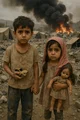
Amir stands barefoot on the dusty ground, his feet coated in dry, cracked soil. His dark brown hair is tousled, matted slightly from sweat and dust. His wide, almond-shaped eyes are full of silent questions as he stares at the distant smoke on a horizon that doesn’t belong to his own country but still feels frighteningly close. His shirt — once white — is now faded and stained at the edges, too big for his frame and slipping off one shoulder. He clutches a plastic toy car, cracked in the middle, holding onto it like it’s a shield against a world that no longer feels safe.
Child 2 – Laleh, Age 5 Beside him, Laleh clings tightly to his hand. Her face is round, framed by long, black hair pulled into uneven pigtails. A faded pink scarf loosely covers her head, slipping backward with each movement. Her cheeks are smudged with dust, and there's a scratch on her knee, half-healed. She wears a dress with cartoon bunnies on it — its brightness dulled by the air and time. In her other hand, she holds a doll missing one arm. Laleh doesn’t cry — not anymore. Her eyes, though young, carry the kind of stillness seen in people twice her age.
Behind them, the sky is a muted orange, heavy with dust and a sense of something distant yet violent. They are not in the war, but they live in its shadow — seeing it on the TV in their village, hearing whispers from adults, and feeling it in the change in their parents’ moods.