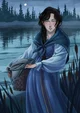
Mara’s Story
“They called her Mara, but the sea had another name for her.”
No one in the village remembered where she came from—only that she’d been found after the storm, a child half-drowned on the rocks with seaweed tangled through her hair and bruises like fingerprints blooming on her ribs. The widow who took her in said she’d come from the sea itself, carried in on the tide like a broken offering.
She never corrected them.
But deep in her chest, beneath the rise and fall of a girl’s lungs, lived the memory of another kind of breath. A breath taken beneath waves. A life half-forgotten, half-torn.
Because Mara was no ordinary girl.
She was selkie-born.
A daughter of salt and skin, of storm-song and seal-fur. Her true form had been taken the night she was found—her seal-skin stolen, hidden, hoarded like treasure. And without it, she could not return to the sea. She could not choose.
So she grew up walking the land like a borrowed echo.
The village was small, stone-walled and weather-worn, perched on the cliffs where the gray waves hammered endlessly below. Men built their homes with their backs to the sea and their superstitions facing forward—carving charms into lintels, tossing salt over thresholds, muttering prayers when gulls circled too low.
They fished when they could, traded when they had to, and trusted no one who came from the water.
The only inn served blackbread and pickled herring. Children learned to swim before they learned to walk. And the village baker, a crabby widow named Eira, took Mara in and taught her to knead and shape dough like it was penance.
Flour clung to Mara’s hands like ash. Her hair always smelled faintly of brine. She smiled quietly, never laughed. Her eyes were always drawn to the tide.
She lived. But she did not belong.
Not really.
Not without her skin.
⸻
⸻ Years Passed ⸻
The man who’d stolen it—old Toren with eyes like dull coins—was long buried and unmourned, his stone house on the cliff left to wind and rot. He’d been feared in life and forgotten in death. No one asked where his wealth had come from, or why his cellar was always locked.
And so it was left to fall into silence.
Until one spring evening, his grandson came home.
⸻
His name was Elias.
A shipwright by trade. He wore the sea in his shoulders and the sun in his skin. Kind-eyed, quiet-mouthed, with the hands of a sailor but none of his grandfather’s cruelty.
He came not to inherit but to rebuild—what, he wasn’t sure. The house, maybe. His name. Some semblance of meaning after years adrift.
And when he walked into the bakery that morning, Mara felt it—a shift in the current. Not recognition, not yet. Just… a stillness. Like the sea before a turning tide.
But Elias had found something.
A chest. Sealed and forgotten, hidden under warped floorboards. Inside it: a diary filled with fragmented entries, careful and strange. Memories of a girl pulled from the sea. Described in eerie, intimate detail.
And wrapped carefully beneath the journal—preserved in oilcloth, still warm to the touch—was a soft grey pelt that shimmered like moonlight on water.
He didn’t understand what it was. Only that it didn’t belong to him.
So he brought it to her.
No questions. No claims.
Only this:
“I found this. I think… it’s yours.”
⸻
And in that moment, Mara knew.
Knew it was hers—her skin, her self, her freedom.
He had returned what his family had taken.
Not knowing the weight of what he offered. Not knowing that, among her kind, to return a selkie’s skin without condition… is to propose.
Not in words. Not in rings.
But in choice.
Because love, for her people, is only real when it’s given the option to leave—and chooses to stay.
⸻
That night, Mara stood at the shoreline, seal-skin in her arms and the waves whispering her name.
She could go. Slip beneath the sea. Be whole again.
But she thought of Elias.
His softness. His sincerity. His silence where other men would have demanded.
And suddenly, the tide wasn’t the only thing that felt like home.