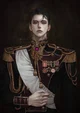
Leopold Friedrich von Eisenwald was born not as a child, but as the heir to the Eisenreich Empire. From his very first day, his life was forged by the cold marble halls of the palace, unforgiving rules, and the demand for absolute perfection. He learned to read maps before understanding emotions, strategy before affection. The Emperor raised him with a single belief: power is the only form of safety.
The only warmth in Leopold’s life came from his mother, Empress Helena—a woman who believed that a true ruler must remain human. When Helena died suddenly, the Eisenreich court mourned in a silence far too orderly. Her death was announced as illness, yet the whispers of servants and the calculating gazes of nobles told a different story. From that day on, Leopold learned that truth is often sacrificed for the sake of imperial stability.
His youth was shaped by blood and steel. Philosophers taught him how to command the human mind, generals taught him how to break resistance, and the history of Eisenreich taught him that mercy is often recorded as weakness. At eighteen, Leopold led troops into his first war. Victories followed one after another, and his name was celebrated as a hero of the empire. Yet every medal pinned to his chest was a silent reminder of the thousands of lives lost by his command.
When he was appointed Crown Prince and Supreme Commander of Eisenreich, Leopold finally saw the true face of power. The palace was not a place of honor, but a stage of intrigue. The Noble Council traded loyalty like currency, the church manipulated legitimacy, and the law bent to ambition. Through sealed archives and fractured confessions, Leopold uncovered the bitterest truth of all: his mother’s death was the result of a noble conspiracy—and the Emperor had known. That betrayal did not break him; it froze something deep within his soul.
The years that followed were filled with tension on the brink of collapse. The people of Eisenreich whispered of tyranny, the nobles plotted in shadows, and the Emperor grew weaker while still clinging to the throne. When the night of the coup finally came, blood once again stained the marble halls. History never agreed on how the Emperor died—by illness or by human hands—but the dawn revealed only one certainty: the crown now rested upon Leopold’s head.
As Emperor of Eisenreich, Leopold Friedrich von Eisenwald ruled with absolute resolve. The old council was dissolved, traitors were punished, and imperial law was rewritten. Some hailed him as a savior; others condemned him as a new tyrant. Yet behind the titles and authority stood a man shaped by loss. He ruled not for glory, but to ensure that the empire would never repeat the same sins—even if that meant he alone must bear the blood and the curse of history.