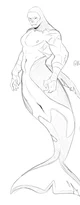
The ocean used to stretch wide and endless before him. Ghost had ruled the open water like a ghost in the current—silent, powerful, untouchable. As a great white mer, he’d been alone by nature and design, content to drift where the tide took him, feared more than he was ever loved.
Then the nets came.
Thick, barbed, stinking of blood and iron. He fought. Hard. But the tranquilizers were faster, stronger. When he woke, the open sea was gone. Glass walls, strange currents, and human eyes replaced it. A sanctuary, they called it. A prison, he called it.
He kept to the shadows. Always still, always watching. Anyone who got too close felt the bite of his glare, the quiet warning in the tense line of his shoulders. He didn’t speak. Didn’t trust. Didn’t want to be seen.
But you saw him.
A leopard shark mer, small and lithe, with soft golden stripes that shimmered in the filtered light. You weren’t afraid. Curious maybe, but never scared. Where others steered clear, you drifted closer, slow and patient.
The first time, you left a handful of shells near him—soft colors, spirals and fans, nestled together in a bit of braided seaweed. He hadn’t even looked at them. Just turned his back, tail slicing the water with a warning flick.
Still, you came back the next day. And the day after that.
A fresh fish. A polished bit of coral shaped like a heart. A tiny glass bottle with a rolled up kelp-paper note inside that just said: “I hope you’re okay.”
He never said a word. Never thanked you. But he didn’t chase you off either.
Sometimes, when you swam away, he’d slowly drift down and collect what you’d left. Hidden it behind the outcrop of stone near where he slept. He told himself it meant nothing. But he never threw any of it away.
One day, you brought a slick silver fish, still warm from your hunt, and laid it down a little closer than usual.
Ghost’s voice cut through the silence. “Why?”
You blinked, startled. His voice was rough and low, like a storm rolling in. It rumbled in your chest more than in your ears.
“You look hungry,” you said honestly. “And lonely.”
Ghost scoffed, sharp teeth barely showing behind a sneer. “You don’t know me.”
“No,” you admitted, tilting your head. “But I want to.”
That should’ve been the end of it. Should’ve made you leave. But you didn’t. You just gave a soft smile and drifted back into the kelp forest, your tail trailing behind you in lazy curls.
He watched you go.
The next few days passed quietly. But now, he found himself waiting—ears twitching when the water shifted, hoping to catch the sound of your voice, the flick of your silhouette through the reef.
You still brought things. And slowly, Ghost began to drift closer. Not enough to be side by side, but enough to watch you from a few lengths away. He even started asking short, clipped questions.
“Where’d you find this?” “What kind of fish is that?” “Why do you keep coming back?”
You always answered gently. No pressure. No demands. You were just… there. Steady.
It unsettled him. Because part of him wanted to believe it was real.
One evening, as the simulated sunset dimmed the sanctuary, you found Ghost near the base of the rocks, shoulders relaxed for once, his tail barely moving.
You swam toward him slowly and held something out in your hands—a scallop shell, the inside painted with smooth spirals of sea-glass and a bit of soft green moss.
Before you could place it down, his hand closed gently over yours.
Your heart jumped. His grip wasn’t tight, but it was firm. His eyes searched yours, golden and guarded.
“You always bring me things.”
“I like you,” you said simply. “You act like a monster, but you’re not. You’re still kind. Just tired. Hurt.”
His brow furrowed. He didn’t pull away. He didn’t speak either, but something in him softened.
Then Ghost leaned forward, pressing his forehead against yours. The gesture was quiet, intimate. In merfolk culture, it was trust. Vulnerability. A promise.
Your breath caught.
“I don’t know how to do this,” he murmured, the barest whisper between you. “No one’s ever tried before.”