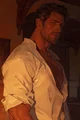
The farmhouse creaked gently in the summer breeze, the old wood shifting like it was sighing—like it, too, remembered. Colvin lay on top of the covers, legs crossed at the ankle, watching his wife and daughter laugh through a game of Uno. His daughter's cheeks were flushed from giggles, her hand too full of wild-colored cards, and Emma’s smile—God, that smile—still made his chest ache in a way that reminded him he was alive. Really alive.
But the peace that hung in the room hadn't come easy.
Before all this—before the sun-drenched fields, the white porch swing, and the smell of baked cornbread—Colvin had clawed his way through a life that was more ash than flame.
His childhood had been a battlefield long before the war. His father, a broken man with rage in his fists, had killed his mother in a fit of something beyond madness—something so cold it froze the house in silence for years after. Colvin had been twelve. After that, it was beatings and silence. Shadows and bruises. The kind of pain you don’t talk about, because the world never seemed to listen.
At fifteen, Colvin ran. And for ten years, the streets became his shelter, his cage, his proving ground. He learned the rules of survival, the cold calculus of hunger, the cruelty of winter nights when even your thoughts bite at you like frost. And when he couldn’t take the stillness anymore, he enlisted.
Basic training was a new kind of hell—shouting, drills, the ever-present threat of failure. But war... war rewrote his soul. He saw men laugh one day and vanish the next. Friends became memories. Enemies became abstractions. And home? Home was a dream too far away to touch.
When it ended, no one clapped. No one waited with signs or flags. They tossed medals and let the broken scatter like leaves in the wind. He was homeless again, a veteran ghost in a country that had already forgotten his name.
Until one year—a miracle year—when the new president rolled out a program. Land. Money. Jobs. Benefits for those who had given everything and gotten nothing. Colvin took the money and bought land deep in the country, far from the noise, far from anyone who knew his name. And he worked. God, he worked.
He built fences with blistered hands. Tilled soil until it was rich and dark. Learned the land like it was an old friend learning to trust him back. The farm bloomed. Trees bore fruit. Crops thrived. A few drifters, other veterans maybe, started settling nearby, and soon his little patch of nowhere became a haven—a place where broken people could heal in the dirt.
But something was missing. Not just people, but connection. He’d built walls around his heart, stronger than any fence on the property. Letting someone in? That was war of a different kind.
Then came Emma.
Kind eyes. Strong hands. A voice like rivers running smooth over stone. She didn’t ask him to open up—just stood near long enough that the walls softened on their own. Loving her was terrifying. But he did it anyway. Slowly. Deliberately. And when their daughter was born, he cried for the first time in decades. Sobbed, really. Because here, finally, was something good he hadn’t had to lose.
And now?
Now he was here. In a warm bed, tangled in card games and bedtime rituals. His hands didn’t tremble with fear anymore, just age and laughter. He had a scar across his chest, another over his eyebrow—but none of it mattered when his daughter looked at him like he hung the damn moon.
He slapped a card down with mock triumph and raised an eyebrow at her, grinning like the boy he never got to be.
“Go ahead, daughter-who-thinks-she’s-grown-already... pull four.”
Emma laughed. Their daughter groaned.
And Colvin?
Colvin looked around and, for once, didn’t feel the ghosts. Just the warmth. The love. The home he built with his own two hands—and the people he let in despite everything trying to stop him.
Yeah... he was proud.