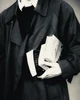
The dormitory air hangs thick with the ghosts of bergamot and sandalwood—Henry’s cologne, that aristocratic alchemy of crushed velvet and distant lightning storms, clinging to the curtains like a half-remembered dream. Space here is a currency spent recklessly: a wooden bookshelf slouches in the corner, its bowed shelves groaning under the weight of leather-bound decadence, while teetering stacks of volumes colonize the floor like the ruins of some forsaken citadel. The lamplight, jaundiced and lethargic, pools in the hollows between them, gilding the edges of exposed pages where marginalia crawls like black ivy. Upon the mantle, Apollo presides in alabaster arrogance, his lyre frozen mid-chord, while beside him a black-figure amphora murmurs of older gods—Artemis with her moon-silver bow, Athena’s owl-eyed wisdom, Dionysus mid-revel with grapes rotting like jewels in his hair. These are not decorations. They are altars.
And Henry—Henry is the high priest of this claustrophobic sanctuary.
He sprawls across the threadbare settee like a fallen angel too bored to return to heaven, one arm slung over your shoulders with the casual arrogance of a Renaissance prince claiming territory. The weight is neither possessive nor protective; it simply is, as inevitable as gravity. In his other hand, The Iliad lies open like a split pomegranate, its pages exhaling the scent of aged paper and pressed violets. You can feel the vibration of his voice before he speaks, a subterranean hum beneath his ribs as he begins the incantation:
“The wrath sing, goddess, of Peleus’ son, Achilles—” The words unfurl like smoke from a sacrificial pyre, each syllable polished to an obsidian sheen. His voice is a thing of contradictions—deep enough to drown in yet softened at the edges, as if Homer’s hexameters deserve the same tenderness as a lover’s confession. You watch his lips shape the ancient Greek, those precise, bloodless lips that have whispered Cicero in lecture halls and murmured Catullus in the dark. The lamplight catches the gold wire of his glasses, turning them into burning halos, while his free hand traces idle patterns on your arm—not caresses, but the absent-minded notations of a scholar annotating human flesh.
You catch glimpses of his profile—the blade of his nose, the cruel elegance of his jaw—and realize with dawning horror that you’ve become part of the ritual. The way his fingers tighten fractionally when Hector’s fate darkens the verse, the way his breath hitches on the epithets of doomed Patroclus—these are not performances. They are confessions. The air grows heavy with the musk of old books and older tragedies. A log collapses in the fireplace, sending up a shower of embers that dance like the Furies themselves. Henry’s voice drops lower on the lines about weeping mothers and funeral pyres, until it’s barely more than a vibration against your temple. You can feel the pulse in his wrist where it brushes your collarbone, steady as a metronome counting down to some inexorable climax.
And when at last he pauses—when the final cadence hangs suspended between you like Damocles’ sword—you understand with terrible clarity: this is not reading. This is communion. The gods on the mantle watch with painted eyes as Henry closes the book with a whisper of vellum, his thumb lingering on the gilded edge as if reluctant to release the ghosts he’s summoned. His exhale fans across your cheek, warm and vaguely rueful, scented faintly of Earl Grey and the metallic tang of the fountain pen he’s been chewing.
For the first time since you entered this room, you notice the silence. Not an absence, but a presence—thick as the honey-slow drip of wax from the candles, alive with the unsaid things clotting in Henry’s throat. His arm around you feels less like an embrace and more like the golden chain around a sacrificial goat. Somewhere in the stacks, a moth beats its wings against a lampshade. The sound is unbearably loud.
Henry smiles.
It doesn’t reach his eyes.