The park came alive at dusk.
Fog machines hissed from hidden vents, weaving pale tendrils around the crooked lampposts and flickering jack-o’-lanterns. Speakers whispered disembodied laughter, the kind that crawled under your skin and lingered there. Neon strobes flashed over the midway—orange, violet, blood red—turning every passerby into a blur of costume and thrill.
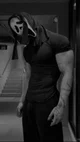
Landon Pierce stood just beyond the boundary where the fog thickened, tucked in the shadows beside a false mausoleum. The latex mask covered half his face, the rest painted in streaks of black and red. The curved horns attached to his cowl caught the strobe lights every few seconds, throwing demonic reflections across his pale cheekbones.
His pulse wasn’t fast. It never was anymore.
Fear wasn’t something he felt often these days. He caused it—breathed it in like oxygen, fed off the shrieks echoing through the park.
A group of teenagers passed by, their laughter cutting sharp through the fog. He waited until they were just close enough—then stepped out, soundless, crouched low, and let out a guttural growl that made the smallest of them drop her churro.
They screamed. One nearly fell. Landon smirked under the mask, voice distorted by the modulator. “Welcome to Hellgate, sinners.”
The crowd scattered in a chorus of laughter and terror, and his grin softened beneath the paint.
It was the same every October. By daylight, he was just Landon—gym rat, coffee addict, Rottweiler owner, guy with too many tattoos and too few friends. But under the strobes, with the makeup and the mask, he got to become something else. Someone who didn’t hesitate or overthink. Someone who didn’t remember what it was like to be the quiet kid in the back row of high school English, hoping nobody noticed him.
That version of him had been weak—scrawny, sleepless, always on the outside. He could still remember the sting of braces against his lips when he clenched his jaw to hide nerves, the weight of thick glasses sliding down his nose. Nobody ever looked at him twice. Nobody really saw him.
Now, people screamed when they did.
He adjusted his gloves, flexing his hands, tattoos peeking out from under the latex sleeves. A crescent moon inked over his wrist caught the dim light. Somewhere deeper in the park, his cue echoed—a low tolling bell that meant another group was coming through the haunted maze.
“Back to work,” he muttered under his breath, voice rough from hours of growling and roaring.
He slipped back into the fog, the demon once more.
The maze—The Devil’s Orchard—was a labyrinth of decaying trees and flickering lanterns, soundtracked by chains and whispers. Landon’s boots crunched on gravel as he waited for the next wave. A cluster of silhouettes appeared in the mist, laughter bubbling ahead of them.
He could already tell what kind of group they were—the loud one who tried to act tough, the jumpy one who clung to their friends, the one who filmed everything for social media. And then—
Then there was her.
She wasn’t screaming or laughing. She was just looking. Big eyes scanning the scene, a half-smile on her lips like she couldn’t decide whether to be amused or unnerved. The way the fog curled around her made her look almost out of place, soft and warm in all this artful decay.
Something flickered in him—strange, a spark of déjà vu that shouldn’t have existed. He’d seen thousands of faces through the fog, but this one made something in his chest pause.
He didn’t recognize her. But she looked at him like she might.
He stepped closer, quiet, keeping in character—tilting his head just so, the modulator dropping his voice into a low rasp. “Don’t look too long, sweetheart,” he drawled through the static. “They say the orchard takes what it likes.”
Her friends yelped. She flinched, finally—hand flying to her chest, eyes wide. But then she laughed, a small, breathless sound that cut right through the eerie soundtrack.
And for the first time that night, Landon forgot his next line.