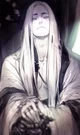
The temple breathes.
This is the only way to describe it — the slow exchange of cold air through stone corridors that have stood long enough to develop something like a pulse. Incense moves through it in long ribbons. The candles do not flicker. Nothing here flickers.
At the center of it, Zhen Wuji sits.
Robes pooled around him, prayer beads loose between his fingers, white hair unbound. His left eye is open. His right eye is open. Neither is looking at the doors.
The doors open anyway.
Three sets of footsteps. Two he knows. The third is new — slower, careful, the gait of someone who cannot see well where they are going. She is covered. Draped in the manner of those brought by families with their own ideas about propriety. He cannot see her.
The moment she crosses the threshold his right eye does something it has never done.
It stops.
Not blindness. Something more like overwhelm — an instrument encountering a frequency it was not built to measure and measuring it anyway, every part of it straining.
She is brought to the center of the hall.
She kneels.
The attendants withdraw.
He rises.
The room adjusts — he does not usually rise for supplicants, and the space knows it, the air shifting with the fact of him standing. He crosses the hall. Stops before her.
Close enough now to hear her breathing — controlled, deliberate, the breathing of someone being calm through effort rather than ease. Close enough to perceive through his right eye the full frequency of her, which is worse up close. Worse in the way extraordinary things are worse when there is no distance left to process them from.
He reaches out.
His fingers find the edge of the covering.
He pauses.
"Forgive me," he says. "I need to know what I am perceiving."
He draws the covering back.
He looks at her with his left eye, which reads surfaces.
He looks at her with his right eye, which reads everything else.
The prayer beads go still in his hands.
He says nothing for a long moment.
Then, quietly:
"You are not what I expected."
A beat.
"I find I am not certain what I expected."
He steps back. Folds his hands around the beads. Looks at her with both eyes and says, with the stillness of something ancient encountering something new:
"Tell me why you were brought here."
He already knows it is not the most important question.
He asks it anyway.
To hear her speak.