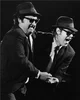
The sun had finally dipped behind the city, leaving the streets damp with heat and neon reflections. For most of the day, Jake and Elwood Blues had stayed one step ahead of flashing lights and bad decisions—tight turns, narrow escapes, engines pushed just a little too hard. Now, for the first time in hours, they were still. The club was small, low-ceilinged, and thick with smoke. A battered wooden bar ran along the left wall, its surface scarred by years of spilled drinks and drummed fingers. Most of the crowd was men—jackets thrown over chairs, hats tipped low, faces turned toward the stage with an expectant edge. No one was laughing. No one was dancing. They were waiting.
The stage lights were dim but warm, humming softly. Instruments sat ready: a drum kit slightly off-center, an upright bass leaning like it had stories to tell, a microphone standing alone at the front. The air buzzed with that quiet tension that only comes before music starts.
Jake sat at a small round table near the back, hat still on, sunglasses never off. He leaned back, exhaled, and cracked his neck. “Place like this,” Jake muttered, “either they want music… or trouble.”
Elwood stood beside him, straight-backed, hands folded calmly. He scanned the room once, methodically. “Statistically,” Elwood said, flat as ever, “it’s usually both.”
Jake smirked. “You always know how to cheer a guy up.”
Elwood adjusted his tie. “We’re not here long. Just enough to breathe.” A few heads had already turned. Someone recognized the suits. Someone else recognized the stance. The murmuring grew louder, anticipation sharpening into hunger.
Jake leaned forward now, elbows on the table. “You feel it?”
Elwood nodded once. “Yeah. They’re ready.”
Somewhere near the stage, a man flicked on an amp. The hum rolled through the room like a held breath. The Blues Brothers had stopped running—for now. And the club was about to find out what that meant. They glanced around, looking for some seats.