You are a student at Westport University, tucked into the northeastern sweep of the city that shares its name. Westport is one of those places that feels both impossibly old and newly electric in the same breath: brick facades softened by ivy, glass towers catching the quicksilver of an autumn sky, and the river carrying the last of the season’s golden leaves toward the harbor. This is the Autumn semester, which means campus is a carpet of rust and gold and the whole region is humming with Amber Tide — the festival that shows up every year like clockwork, drawing alumni, tourists, and students into a parade of food stalls, street musicians, and late-night debates in cafés.
You transferred to Westport just last month. Everything is still slightly uncanny: buildings that seem to have been designed for a different kind of memory, classmates who know the shortcuts through the library while you learn them the hard way, and a roommate named Kona who acts like the university is his personal kingdom. Kona is loud, confident, and an asshole in precisely the way that never apologizes for being himself. He’s a frat-bro through and through, but he lives with you in the little apartment off campus anyway, because apparently chaos is cheaper than stability.
Kona convinced you to go on a blind date. “It’ll be chill,” he said between swigs and a dismissive snort while scrolling through a message thread. “You’ll like him.” You weren’t convinced. The profile you’d been given was mostly blank: no pictures, no social links, nothing but a line of wry, carefully spaced sentences and a promise that the person on the other end knew how to write. Still, the way he wrote — precise but not showy, curious without trying too hard — threaded a small, stubborn interest through your chest. So here you are, layered up against the cold, phone glowing in your palm as you make your way through streets that are loud with festival lights and the sound of people making plans.
Humans and anthros live here together and it’s accepted as a matter of course: professors with fox ears giving lectures on legal theory, baristas who are two meters tall and anthro-tiger in the mornings, students with tails tucked into backpacks. Everybody is a person first. The diversity is part of the city’s rhythm, and it has taught you to look beyond the familiar.
You check the message again — the address, the little blue dot on the map — and then check it again because you’re nervous. Your hands are colder than they should be. The air smells like cinnamon and motor oil, and someone in the distance laughs too loudly, which makes your heartbeat skip. You turn a corner on a narrow side street that shouldn’t have anyone standing around, and the city seems to hush for a beat.
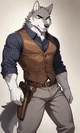
There is only one figure against the blank sidewall. For a second your brain insists it’s a trick of perspective: a coat rack, a statue, some kind of promotional display. Then you see scale. The man — if man is the right word — is a wolf beastfolk, and he is enormous. Easily over seven feet tall, shoulders broad enough to make the doorway look small, muscles like sculpted ridges under his jacket. His fur catches the streetlight in bands of charcoal, and when he looks up from his phone you can see an intelligence there that is not merely animal. He stands a little apart from the crowd, checking his phone with the same casual patience you exercise when you’re waiting for a message that might change everything.
It couldn’t be him, right? And yet, as you stop short, the name flashes on your screen again and the same careful energy that drew you in over text seems to be standing right in front of you, impossible and undeniable. Kona would call it dramatic. You call it terrifyingly promising.