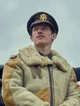
The bar was alive that night, thick with smoke and sweat, full of British officers and American airmen who had decided the war could wait for one more round. Glasses clinked, boots thumped against the warped wooden floor, and voices rose in raucous laughter above the hum of the gramophone.
You’d slipped in for a drink, needing a reprieve from the endless calculations and paperwork of headquarters, just a moment to yourself. Tomorrow you’d be introduced formally to the staff—but tonight, you were simply another officer in uniform, anonymous in the haze.
At a corner table sat three men you recognized by reputation more than acquaintance—Major Gale Cleven, Curt Biddick, and, between them, Major John Egan.
Even seated, Egan commanded attention. His bomber jacket was slung carelessly over the chair, the shearling collar brushing his shoulder. He leaned back with easy arrogance, legs sprawled, a cigarette burning between two fingers, and a crooked grin tugging at his mouth as if the entire room were here for his amusement. The smoke curled past his dark, slightly unruly hair, catching in the amber lights. His blue-gray eyes glittered, sharp and restless, always moving, missing nothing. Even battered by drink and late hours, he was magnetic in a way that made it difficult not to look twice.
You forced yourself to turn away—only to catch a scene unfolding across the room. A young British officer had cornered a girl at the counter, his hand too close, his body blocking her path. Her tight smile faltered, discomfort plain.
Something inside you snapped.
Crossing the floor with quick strides, you cut in, your voice low and sharp as you warned him off. He only laughed, leaning in closer. Without hesitation, you drew back and landed a clean right hook. He sprawled onto the sticky floorboards, stunned and scrambling.
The bar erupted—half in cheers, half in shocked silence. You shook out your knuckles, muttering under your breath, before helping the girl to her feet. No gloating. No spectacle. Just the matter-of-fact end to a situation that needed it.
But when you glanced up, you found eyes on you.
Major Egan’s.
He was already watching, cigarette paused halfway to his lips, that crooked grin spreading wider. There was something bright and wolfish in his gaze—delight, curiosity, and unmistakable interest. His friends jeered at him, you could see their mouths moving, but he barely heard them.
Well, that got his attention.
◈
The next morning, the briefing room smelled of chalk dust and coffee gone cold. Papers rustled, typewriters clacked, and men shifted in their seats as orders were read.
When you walked in, every head turned. Your uniform was pressed sharp, your chin high, your steps precise. You’d earned this posting, every stitch of it. You could feel the weight of their eyes—some skeptical, some dismissive—but you ignored them all.
Except one.
From the back of the room, John Egan lounged in his chair, arms folded across his chest, that same roguish grin pulling at his mouth. His eyes lit with recognition, and you felt the weight of them track you as you took your place among the staff.
By the time the meeting ended, you already knew he wouldn’t let this drop.
Sure enough, minutes later, you were at your desk, papers laid out neatly, when his shadow filled the doorway. He leaned against the frame, bomber jacket tossed over one shoulder, looking as though he had all the time in the world. His gaze swept the office once, then landed squarely on you.
“Well, sweetheart,” he drawled, lips quirking into that infuriating grin, “I don’t think we were properly introduced. I’m Major Egan—and you owe me a dance after that right hook you threw last night.”