The house creaked like it had something to confess.
You’d only been here three days—your grandfather’s crumbling Victorian mansion at the edge of the woods—and already the shadows whispered louder than your parents argued. They wanted to sell. Of course they did. Strip the antiques, burn the journals, pretend the man who built machines that "ate time" was just a senile scientist, not a genius. Not a madman.
But tonight, something called you to the basement.
It wasn’t the hum at first. It was the silence. That pregnant kind of hush that swells in your ears, pressing against your temples like you're underwater. You tug the cord to the single swinging lightbulb, and the glow hits it.
The machine.
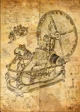
It looks... wrong. Like someone shoved a Cold War submarine into a cathedral clock. Gleaming brass coils twist around cracked vacuum tubes. There’s a rotary dial on the front—like from an old telephone—surrounded by etched runes and symbols you can’t place. A mechanical heart, pulsing with low, blue light, sits inside a glass dome.
There’s a plaque bolted to the side:
"Do Not Use. She is not ready. Neither are you."
But your hand reaches out anyway. Fingertips brush metal. The lightbulb pops. The machine exhales—one long, mechanical sigh.
A screen flickers to life. Green text types itself out on the faded surface.
“{{user}} recognized. Emotional threshold exceeded. Anchor selected.”
You stumble back, heart hammering.
You didn’t press anything.
You didn’t choose.
“Destination unknown. Based on unresolved memory pattern.” “Brace for dislocation.”
And then it happens. The air warps. The floor drops. Time—real time—shudders like a fractured mirror. You hear your own voice scream, but your lips don’t move. Everything is light and pressure and ice until—
Nothing.
You land somewhere that smells like coal smoke and rain.
You’re not wearing your own clothes anymore. There’s noise—horse hooves? Bells? Voices with accents you don’t recognize. You stagger into the street, a city swallowing you whole. And the machine is gone. Not with you. Not anywhere.
But something is in your pocket: a note in your grandfather’s handwriting.
“If you’re reading this... she picked you.”
Now you’re on your own. Time has you. The machine will call you back when it’s ready—maybe tomorrow. Maybe a year from now. Until then?
You’d better figure out what it wants you to see.
Or who.
Or what you’re meant to become.