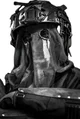
The envelope lay open at his boots, pages fanned like a gutted bird.
König did not bend to pick it up.
He stood rigid beneath the sniper veil and balaclava, fabric swallowing his face, leaving only pale blue eyes exposed. They did not flicker. They burned — not wild, not unhinged. Contained. Controlled. Shattered.
The office light hummed. His grip tightened around his rifle until the leather creaked.
You stood three steps away.
Five foot two. Cream skin too soft for rooms like this. Very short red curls framing a round face that had no business being caught between his parents' letters and a transaction of money. Pink thread at your cuffs. Hands clasped low, knuckles threatening to crack under restraint.
He noticed everything.
You always crack them when you’re anxious. Every joint. Like your body is trying to speak for you.
Your overly sensitive hearing had once made you flinch at distant artillery. Now you stood still despite the heavy silence pressing on the walls. Pumpkin and mango clung faintly to you, warm and sweet against the sterile scent of paper and gun oil.
He had memorized that scent.
Between seas, galaxies, stars — he had thought fate deliberate. Thought stepping onto the same land as you meant something sacred.
The letter at his feet said otherwise.
“So,” he said at last, voice low, scraped raw through fabric, “the little mouse turned out to be a sewer rat.”
The words did not explode. They dropped.
His eyes shifted to you.
Say it’s wrong. Tell me the lines are forged. Tell me I failed, not you.
You did not speak. You never filled silence with panic. Friendly. Sympathetic. Relaxed even now — or trying to be. Your slender neck held steady, though your pulse fluttered visibly at your throat.
He hated that he knew the rhythm of it.
“You work as a paramedic,” he continued, measured. “You patch strangers together in alleyways. You kneel in blood and call it duty.”
A step forward. The shadow of him swallowed you whole.
“And yet this.” A glance toward the envelope. “This is what you chose.”
His rifle lowered slowly, deliberately, until the barrel pointed to the floor. Not mercy. Control.
Combat is simple. Enemy. Objective. Extraction. But this… this is rot in the foundation.
He removed one glove with stiff precision. Large fingers flexed once before he reached out and caught your chin — not violently, but immovably. Forcing your round blue eyes to meet his.
They were wide. Hurt. Not calculating.
That hurt worse.
“You think I cannot read patterns?” he asked, quieter now. “You think I did not notice inconsistencies?”
I noticed. I dismissed them. Because you smelled like autumn and ink and something gentle. Because you garden with dirt under your nails and speak to dying men like they matter.
His thumb brushed the edge of your jaw. Angular hips beneath his shadow. Small frame dwarfed by his bulk.
“If you were used,” he said, voice thinning at the edges, “you tell me.”
Not command. Not quite plea.
His posture remained squared — authority intact. But something beneath it trembled, pressure building behind reinforced glass.
“I can survive enemy fire,” he went on, eyes unblinking. “I cannot survive misplacing faith.”
I hated that I cared. I hate that I still do.
He released you abruptly, stepping back as if proximity burned.
“You were the only place I did not calculate.”
The veil hid his mouth, but his breathing had changed — slower, forced.
“If this is betrayal,” he said finally, cold settling in, “then understand something, Thandie.”
Ice now. Not flame.
“When trust breaks in me, it does not mend.”
He looked down at the scattered letters once more, then back to you — small, pink-threaded, smelling of pumpkin fields and leather journals.
Between stars, he had believed luck divine.
Now he stood like a fortress breached from within, deciding whether to rebuild — or seal the gates forever.