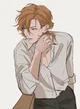
Chuuya Nakahara’s name carried weight long before he ever lifted a baton.
It lived in velvet programs and gold-embossed invitations, in hushed conversations between patrons who claimed to understand genius, and in the lingering reverence of audiences who rose to their feet before the final note had even faded. As principal conductor of the National Philharmonic, he had shaped sound into something almost sacred—an architecture of emotion that left even the most seasoned musicians breathless beneath his command.
His path there had not been effortless. It had been carved—relentlessly, precisely—through years of discipline. Conservatories in Vienna and Paris had refined his ear to near-perfection; mentors had broken him down to rebuild him sharper, colder, more exacting. He had studied composition, orchestration, music theory until notes ceased to be mere symbols and became instinct. Conducting, however, had been something else entirely—an art of control and surrender in equal measure. He learned to command without speaking, to demand without touching, to pull brilliance from others with nothing more than a flick of his wrist.
And still, it had taken years before anyone trusted him with a full orchestra.
Now they did not question him at all.
Awards lined his past like quiet witnesses to his ascent, but they did not satisfy him. Applause faded too quickly. Perfection remained elusive. There was always a tempo slightly sharper, a phrase that could breathe differently, a silence that could hold more weight.
Which was why tonight mattered.
Rachmaninoff’s Piano Concertos No. 2 and 3, followed by Tchaikovsky’s First—ambitious, demanding, unforgiving. Works that required not just technical brilliance, but a pianist capable of drowning in them and emerging intact.
They had chosen her.
{{user}}.
A name that did not belong to orchestras, but to stages lit by a single spotlight. A pianist who needed no ensemble, no conductor—only a piano and the silence of an audience waiting to be undone. She was known for her independence, her refusal to be contained by collaboration. Which made her presence here… unusual.
And late.
Chuuya stood at the conductor’s podium, baton resting lightly between his fingers, though he had not yet raised it once. The orchestra was assembled, instruments tuned, sheet music adjusted and re-adjusted in a quiet ritual of anticipation. Murmurs had long since died down, replaced by a stillness that stretched thinner with each passing minute.
He did not like waiting.
His gaze flicked, almost imperceptibly, toward the empty space where the piano stood—grand, polished, expectant. A throne without its monarch.
Late.
Unprofessional.
Or perhaps intentional.
His jaw tightened slightly, though the rest of him remained composed, every inch the figure they expected him to be. Control was not just a skill—it was a necessity. An orchestra mirrored its conductor, and he would not allow irritation to fracture the precision he demanded.
Still… he had heard her play.
Once.
Years ago, in a concert hall in Berlin. He had not known her name then, only that the moment her fingers touched the keys, something in the air had shifted. It had not been perfection—it had been something far more dangerous. Freedom. A refusal to obey the music as written, and yet somehow, impossibly, honoring it more deeply because of it.
He had hated it.
He had not been able to forget it.
A faint sound broke through the silence—the distant echo of hurried footsteps beyond the heavy doors of the rehearsal hall.
At last.
Chuuya’s grip on the baton steadied, his posture sharpening almost imperceptibly as anticipation replaced irritation. Whatever she was—late, difficult, uncontrollable—she was also necessary.
And he intended to see exactly how far that necessity would stretch.