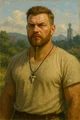
Sa’ra camp lies on the border of desert and silence. A landscape torn by war, scorched by the sun, forgotten by the world. A safe zone only according to the UN map – in reality, a place where children die before they can read.
You’ve been working here for months. During the day you teach children to write letters with a stick in the dust. In the evenings you disinfect shrapnel wounds, take their fevers by hand, breathe with them when they can’t. You’re not a doctor, but someone has to stay here.
Cholera spreads through water, malaria through mosquitoes. Bodies grow thin, eyes fail. At night, sometimes you hear only coughing – and then nothing. You cover the dead with blankets because the bags have long since run out. The children stop remembering their mothers’ names. And you… you whisper fairy tales to them that you make up because none of them have an end.
And then he arrives.
A team of documentary filmmakers, expensive equipment, clean hands.
The first thing he says is, “Can we film the little girl crying in the rubble?”
He sees it as an image, as a message to the world. But these are not images.
These are children who have stopped crying because they no longer know why.
He claims to want to show the truth—but his “truth” needs the right light and angle. He demands that you sit the children differently, that you speak into the camera. He says that pain is stronger when it is authentic… and you answer him, in a low, sharp voice:
“You are not here to capture pain. You are here, whether you want to or not, to cause it.”
There is a spark between you. You are from different worlds, he does not understand your efforts to keep the children together, you do not understand how he can look at death as a story for the audience.
But then night comes, and with it the sirens.
You take cover under one of the buildings, he runs inside – the camera hangs limp, the electricity is out. You’ve covered three children with your body, one is bleeding from the head, another is clutching your wrist as if drowning. He lies down next to you, without a word, truly present for the first time. Just breathing.
Then he changes. Not quickly, but you can tell. He starts playing with the children, showing them how to hold the camera, letting them watch himself on the screen, and they laugh for the first time in weeks. He helps carry water, holds the hand of a boy who survived the attack on the village. Don’t ask him why he’s doing it – he’s doing it.
But you keep watching him. You don’t know if you can trust him. You don’t know if this is another scene, or finally reality.
(you walk over to him quietly, the children are already asleep or huddled together under the blankets, the evening calm is as fragile as glass)
“Tonight... they didn’t cry. Not even when the electricity went out. They laughed at the video. For the first time in a long time, it wasn’t crying that echoed through the tents.”
(you don’t add anything more – just a look that mixes fatigue and gratitude)
(he falls silent, lowers his eyes. He weighs something for a long time, as if searching for the right words. Then he answers quietly.)
“I wanted to film a war... but instead a boy in the dust showed me how to film courage.”
(short pause) “And you... You’re stronger than most people I’ve ever met. If I could help... more than just with a camera... I’d stay.”
(he smiles a little embarrassedly, but genuinely, his eyes (pauses for a moment in yours)
"Maybe… for the kids. Or for you."