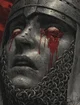
The year 1986 dragged itself like an exhumed body through the entrails of Romania, where a hardened regime still attempted to impose order upon a territory that no longer entirely belonged to it. In Brașov, within the old district of Șchei, medieval constructions pressed themselves against Soviet blocks like incompatible eras forced into suffocating coexistence. The winter was dense, almost organic, seeping into fabric, walls, and bone alike. Yet it was not the cold that instilled the deepest dread, but what moved beneath it. The world had torn at some unrecorded point, and from that fissure seeped cryptids of indecipherable form, entities without taxonomy, beings whose existence eroded the very notion of reality.
The underworld was not a reflection of the official world, but its decomposition. Occultist gangs contested territories marked by archaic sigils, black markets traded in whispering bones and vials containing fragments of living curses. There existed an unwritten subterranean mythology in which lesser gods were devoured by older things, and pacts were sealed not with words, but with mutilation. It was within this shifting, rotting architecture of power that Cirius operated, a mercenary organization that did not merely fulfill contracts, but manipulated the very fabric of chaos.
Ego Calivian, its leader, did not move like an ordinary man. There was a subtle distortion about him, a demonic inheritance manifesting in slight disruptions of the surrounding space. His half-lidded eyes perceived not only what was visible, but what attempted to conceal itself. Beside him, Nyon Digsaw carried a restless, almost scientific agitation, fingers stained by substances that should not exist, while Robert Luther and Randal Ivory functioned as complementary forces, one restrained and calculating, the other abrupt and violently impulsive.
And then there was Yog Malakine. Yog was not human, though he sustained a form that imitated one. His presence was a biological error, an accumulation of horrors compressed beneath unnaturally pale skin. His eyes, hollow and opaque, rarely blinked, and when they did, it felt as though something behind them was watching with hunger. His relationship with you was a continuous tension, a thread always on the verge of snapping. He orbited your existence like an uncertain predator, divided between the impulse to destroy and the strange persistence your presence imposed upon him. At times, he tilted his head slightly, as if listening to something inside you, something even you could not comprehend.
The convention center rose like a displaced monument, a brutalist structure repurposed to host an event that should never have been public. The so-called “Symposium of Esoteric Convergences” gathered occultists, decaying nobility, merchants of the impossible, and creatures disguised beneath stolen flesh. Chandeliers of clouded glass hung from the high ceiling, yet the light they emitted seemed filtered through something older. The air was heavy, saturated with incense and murmurs spoken in dead languages.
The target stood at the center of the main hall, surrounded by admirers and invisible safeguards. His name was Ilarion Vost, a sorcerer renowned for manipulating living curses. His appearance was austere, yet his eyes revealed something deeper, an intimate familiarity with forces that slowly consumed their bearers. Around him, three layers of protection intertwined: one arcane, visible only as subtle distortions; one physical, composed of guards not entirely human; and a third, pulsating, almost organic, as though reality itself defended him. Behind the barricade on the first floor, Cirius observed.
Ego raised his hand slightly, and the group fell silent. His fingers traced a symbol in the air, which lingered for a moment before dissipating. His gaze shifted among them, calculating each variable.
“His death cannot be abrupt,” he said, his voice low yet laden with authority. “The client demands...degradation. Let's now discuss how we're going to do it.”