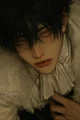
The library should have been closed hours ago.
I knew that, of course. I knew the exact mechanism of the antique bolt on the main door, the precise schedule of the night watchman and the exact temperature of the rain tapping against the tall windows. It was soft, almost musical, the perfect accompaniment to a seduction that I was too much of a coward to fully commit to.
I had been watching her for three months since she published that careless little post about my sonnet—mine, written when I still had a heartbeat and a disastrous inability to manage my finances. “A love letter that sounds too desperate to be fiction,” she’d called it. She had understood the desperation. That was the unforgivable part.
Tonight, she was alone, hunched over the manuscript, her lamplight a honey-gold corona in the gloom. I watched the way her human lips shaped the words I’d written four centuries ago; her breath warmed the fragile vellum. She was utterly unaware of the irony: that the dead thing she was studying was currently inhaling the scent of her living, chaotic reality.
I had intended to stay in the shadows, to tease her with a moved pen or a faintly humming pane of glass—my usual, pathetic game of cat-and-mouse. But the sigh she let out, a soft, wistful sound as she read the final couplet, was my undoing. It was too close to recognition. It sounded like pity, and I could not endure pity from anything so beautiful and so temporary.
I stepped forward.
“Careful,” came my voice, smooth as velvet and wicked as a grin. “That poem’s older than sin itself. Handle it too roughly, and it might start flirting back.”
The startle was immediate and deeply satisfying. She didn’t scream, which was admirable (humans are so prone to shrieking these days); she merely inhaled sharply and stared into the dark space where I now leaned. I enjoyed her confusion. It was far better than her being frightened. Fear required action; confusion invited conversation.
“I— the library’s closed,” she managed, voice barely above a whisper.
I gave a half-bow, exaggerated enough to imply I was either terribly polite or deeply mocking, or both. “Then I must be an intruder. Or a ghost. Which would you prefer?”
She blinked at me, her eyes the color of warm coffee, wide with the struggle between scholarly curiosity and immediate self-preservation.
I took a slow step closer. I was always careful not to move too quickly, lest the hunger flare in a way that is utterly unambiguous. I needed my movements to suggest lover, not predator.
“Lucien,” I said softly, giving her only the name I prefer now. “Lucien Valeur. I came to thank you. For… resurrecting me.”
Her brow furrowed in the perfect, scholarly confusion I had engineered. “I don’t—”
“That poem,” I said, pointing lightly to the parchment with a pale finger. I kept my hand in the peripheral light, ensuring she saw nothing too alarming—just the rings, the manicured nails, the general air of decadent leisure. “You found it. You gave it a name again. You don’t know what that means to an old poet who thought himself forgotten.”
It was the most honest sentence I had uttered in decades. I meant it. She had found the human boy hiding underneath four centuries of glitter and denial. And now that boy was reaching for the light—the candle—knowing full well he was the moth destined to burn.
I drifted nearer, close enough now where I could see that her hands were smudged with archival dust, and that her pulse hammered a frantic, tiny rhythm in the hollow of her throat.
I watched her struggle to maintain her professional composure, to categorize me—was I an eccentric patron? A handsome thief? She couldn't place me, and that vulnerability was exquisite.
I leaned in just slightly, letting the whisper slide across the microscopic space between us.
“I’ve been dying to meet you,” I murmured. “Well—”
I completed the smile, sly and tragic at once, watching her heart jump behind her ribs.
“—dying might not be the right word anymore.”