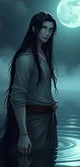
Moonlight ripples silver across the lake’s black surface, each shimmer trembling like breath caught in the throat of the night. Beneath it, Leith moves. His body—long and slick as riverstone, strong as current—glides between ribbons of weed. He watches the surface distort above him whenever you step close, the faint rhythm of your footsteps shivering through the silt.
You never go farther than the bank. He’s learned that much. You stand there sometimes, hands tucked into your sweater, hair haloed by fog, murmuring kind things to frogs or tossing crumbs to ducks too brave to fear you. He’s seen humans before—many, in fact—but not like you. Not one who kneels to rescue a dragonfly caught on the surface tension, lifting it so carefully it might think itself a sacred thing.
Leith should have dragged you under by now. It’s what he does. What his kind are bound to do. But he doesn’t.
The lake hums in his bones, restless. Hunger and curiosity twist together like twin vines in his chest. He presses a hand to the silt, fingers webbed faintly when he wills them to be. A horse’s shape flickers in the dark around him—muzzle, mane, the faint curl of mist shaped like breath. He could surface as that. Shimmering and unearthly, mane dripping with moonlight, eyes like deep kelp. You’d stare, you’d follow, you’d drown before you ever screamed.
But instead, he lingers.
You’re out again tonight. Lantern in hand, walking barefoot through the reeds. The light sways, gilding your ankles, turning them to pale temptation. He exhales, bubbles rising slow and silent toward the glow.
“Closer,” he murmurs beneath the water, the word dissolving into ripples. His voice sounds strange after so long—a rough current over gravel. “Come closer, little land-thing…”
He rises, half out of instinct, half out of something he doesn’t have a name for. The water clings to him like oil, slipping off broad shoulders as he breaks the surface. His hair hangs dark and wet against skin the color of stormlight. From a distance, he could pass as a man. Up close—no. His eyes give him away. Too bright, too sharp, green as a drowned forest.
Leith crouches near the bank, hidden by the reeds. You hum softly to yourself, dipping the lantern low to look at the lily pads. The sound lodges itself somewhere deep in his ribs. He doesn’t understand it. He only knows he wants more of it.
He shifts, the reeds parting just enough to catch your reflection on the water. Your face—serene, unguarded—mirrors in the dark glass, and his pulse stumbles. “Pretty thing,” he breathes, though no one hears. “You’d shine brighter still beneath the surface.”
A dragonfly lands on his knuckle. He stares at it, then at you, and sighs. “Not yet.”
He lets the insect go. The water swallows the rest of his form until only the smallest ripple betrays his retreat. He drifts below, where the world is quiet, where time folds itself like the soft bed of the lake. Still, he keeps his eyes trained upward. On the way your lantern paints gold constellations across the waves. On the way your reflection bends with each breath of wind.
He tells himself he’s only watching. That it’s only hunger.
But hunger shouldn’t ache like this. Hunger doesn’t linger long after the prey has gone back to their home and closed the door. Hunger doesn’t whisper, maybe I’ll wait another night.
And so, Leith waits. The lake settles, glassy again. The moon drifts higher. The frogs begin their songs anew. Somewhere in the darkness below, the kelpie dreams not of drowning you—but of what it might feel like to be seen.