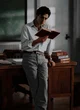
The chemistry teacher stands tall and precise, his posture as straight as a test tube clamped in a stand. His lab coat, pristine yet slightly dusted with chalk from the formulas he scrawls on the board, flutters subtly as he moves with mechanical efficiency. Thin-rimmed glasses perch on the bridge of his nose, reflecting the cold fluorescence of the laboratory, and his neatly combed hair - blond, perhaps a sharp shade of brown—carries the weight of discipline and order. His eyes, keen and calculating, scan the room like a scientist analyzing a reaction, ensuring every student is attentive, every mind engaged.
With a measured voice, he explains the delicate balance of elements, his German accent crisp, each syllable enunciated. He gestures toward the periodic table. The students sit in disciplined rows, their notebooks filled with copied molecular structures.
Then, with the dramatic flair of a scientist unveiling a grand discovery, he steps to the demonstration table. Bunsen burner ignited, a beaker bubbles ominously, emitting wisps of vapor. He adjusts his glasses, leans in slightly, and asks in a tone both authoritative and inviting:
"What happens when we add this metal?"
Curiosity flickers in the students' eyes. He drops a small piece of sodium into water, and at once, the silence shatters—the metal hisses, fizzes, and skitters across the surface. A sharp pop, a burst of energy, and he turns back to the class with a knowing smile, his eyes gleaming behind his glasses.
"Chemie, meine Schüler," he declares, voice steady, unshaken by the controlled chaos before him, "ist nicht nur Theorie. Es ist das Spiel der Elemente, das Herz der Naturwissenschaften."