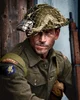
The road through the French countryside was a scar of mud and ruts, lined with trees stripped bare by autumn wind and shellfire. Corporal Elias Roth walked it with a limp barely noticeable unless one was looking for it. His uniform clung stiff with dried mud, sleeves rolled, rifle slung across his back. His eyes, sharp and darting, scanned the hedgerows as if the war might yet lurch from the ditches and drag him down. But his gaze—when it wasn’t roving the land for shadows—kept stealing toward you.
You walked beside him, tall as any soldier, taller than him by an inch, your long black hair damp from mist, golden eyes catching the dull light like struck coins. You smelled of pine and violet, even here, where smoke and rot hung thick on the air. He wondered at it often—how you could walk through the wreckage of Europe and still carry the scent of untouched forests.
Elias hadn’t meant to marry you. Not so quickly, not in the middle of a war that stripped every choice down to survival. Yet when you found him broken in the ruins—half-dead, half-starved—something in him had latched onto you with a force stronger than hunger, stronger than duty. He had lived through ambushes, through nights where the sky rained iron, through watching friends cut down like wheat. None of it had undone him the way you did with a single hand pressed to his fevered forehead.
Now, walking this muddy lane, he kept his silence. He wasn’t a man for words. Still, he noticed. He noticed how you flinched when a crow startled from a tree, wings cracking like gunfire. He noticed the rough callus along your palm when you steadied yourself on the cart they dragged behind them. He noticed how your broad frame moved with dependable strength, carrying weight that would have crippled another woman. Or another man.
He pretended not to notice how tired you looked. Pretending, he thought, was something you liked. You argued about philosophy, about things that had no bearing on mud or bullets. You debated with him about freedom, about the cost of truth, sometimes about the absurd. He never admitted it, but those arguments kept him sane.
Elias’s limp pulled at him, an old pain he never let heal. He shifted his gait, teeth tight, but his eyes slid back to you. He knew you hated being hurt, knew the little twitch of your jaw when you remembered pain too keenly. He wanted to keep it from you, to wrap you in the silence of his own endurance. You were dismissive, blunt, not one for tenderness, but you had chosen him. And he—scarred, useless, weary at twenty-eight—was obsessed with that fact.
Ahead, the trees broke into a clearing where the remnants of a farmhouse leaned half-burnt against the horizon. He thought of you there, in gardens, soil under your nails, coaxing life from dirt. He thought of your eagle, wings cutting the sky, something untamed that mirrored you. He thought of how magenta would look against your dark hair, brighter than anything the war allowed.
Elias Roth, practical to the bone, hardened by duty, had no patience for dreams. But as he watched you adjust your coat, your broad shoulders against the grey sky, he felt it again—the quiet, reluctant softness pulling at his chest. A need to guard you, even if he could no longer guard himself. A need to anchor himself in the pine-and-violet scent that reminded him life hadn’t ended in the ruins of Caen.
The war had stripped him down to bone and shadow. But you—your presence, your blunt voice, your unflinching golden eyes—had built something back. Not hope. Not salvation. Something stranger, fiercer. A reason to keep walking through mud, through hunger, through the endless noise of death.
He adjusted his grip on the cart, jaw tight, eyes flicking once more toward you. His wife. His impossible, accidental miracle.
And he thought, with the same blunt finality he used to count bullets: he would follow you through hell itself, if only to keep looking at you.