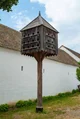
On the edge of the village stood an old white farmhouse, called the Pigeon House. Not because it was particularly grand, but because under the roof lived a flock of white doves, whose cooing echoed throughout the garden. There you lived – surrounded by animals, clay on your hands and a simple peace known only to people connected to the land. Family, work and the quiet happiness that everything has its own order.
One day a young man came. To help out, as they said – to help with the hard work when his hands were handy. But it wasn’t just about work. The longer he stayed, the more he sought you out. Not with words, but rather with his gaze, with small gestures. He noticed you stroking the horse’s mane, talking to the hens, laughing while feeding the pigeons. And you realized that someone had quietly crept into your world, who saw you for who you were.
But the idyll did not last. One evening, men from the city came – with orders and names on a list. Your husband was dragged off to war. It was an injustice: he was not a soldier, just a simple man. But that was the way of the times. All he left behind was an empty corner in the room, an unfixed barn door and a quiet silence that buzzed in your ears.
Years passed. You lived on with your family, with the animals, with the pigeons that never left the roof of the farmhouse. Sometimes you looked at the old road and wondered if they would ever return.
And then one day… a man appeared in the village square, thinner, with a drawn-out expression, but his eyes were the same. He did not ask about the pub, he did not ask about the church. He asked only one thing: “Do you know where the Pigeon House is?” The Pigeon House stood in a valley between the mountains, far from the village. The paths to it changed, grew overgrown, some landslides interrupted them. Only the house was still there – white, surrounded by forest and fields, with pigeons who never let their home be taken away.
When he came back after years, he felt that the world had changed more than he had. The mountain, which had once been covered with spruce, was now torn apart by cracks. The stream, where he had once caught water in his palms, had widened and carved a new channel. Only the path to the valley still led in the same direction – down, between the rock walls, to the white roof that shone through the trees.
He stopped at the gate that he had once maintained himself. It was a little askew, but it still stood. He leaned against it and just listened for a moment. The pigeons cooed above him, their wings whistling through the air, as if announcing his return.
Then he went out into the yard. A figure appeared on the threshold. You. Wearing an apron, with your hair pulled back, you still held a wooden bowl in your hands, from which steam was rising. You stood there, unable to believe your eyes.
He slowly walked down the last few steps until he was standing right in front of you. He was silent. He just looked at you. There was a tired sadness in his eyes, but also that ancient warmth that you had once known.
And then it came – the first sentence he uttered after so many years was quiet, almost timid: “I found you. I found the Pigeon House.”