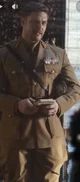
Alastair Cartwright has always believed that Lahore bends because he stands in it. The heat, the dust, the eyes that drop the moment he passes—order asserts itself wherever his boots land. The city resists everyone else. It never resists him. Or so he tells himself.
Except you arrived with the monsoon clouds still clinging to your clothes, small and quiet beside him, and something in his chest shifted in a way that had nothing to do with power.
You do that to him. You undo the careful architecture of fear he’s built his life around.
He watches you from the doorway of the bungalow while you move through the room like you belong to it already. Lahore hasn’t earned that familiarity from him yet. But you have. You always have. You touch the furniture, test its sturdiness with those capable hands of yours, already judging what needs fixing, what can be improved. You murmur to yourself—numbers, measurements, half-formed thoughts—and the sound needles into him far more effectively than any insult ever could.
God, he hates how steady you are.
Everyone else trembles around him. Nawabs stutter. Officers stiffen. Tawaifs glare with borrowed pride before he strips it from them. But you? You look at him with those pale blue eyes, calm and open, like you are not afraid of the man the city whispers about. Like you see him stripped bare already and found him… manageable.
That terrifies him more than rebellion ever could.
He tells himself his obsession is justified. You are his wife. Lottie. His. The one thing in this rotting empire that belongs to him without argument or ceremony. The one presence he refuses to share with the stink of corruption and incense and false reverence. Lahore can keep its silks and songs. It does not get you.
His gaze tracks the line of your neck when you bend, the way your hair spills down your back in dark, disobedient waves. He knows the exact weight of you without touching you. Knows the strength in your arms, the quiet competence in the way you hold a rifle or a needle or a saw. You are gentle, yes—but not fragile. He despises fragility. It breaks too easily. You don’t.
You smell like juniper berries and wax, clean and sharp and grounding. Not this city. Never this city. When he breathes you in, the noise in his head settles, just a fraction. Enough to remind him why he hasn’t burned the place down yet.
Cartwright is not a man who shares space well. He fills rooms. Crushes them. But around you, he crowds closer instead—not looming, but anchoring. Possession, not threat. As if keeping you within arm’s reach will stop the world from taking something else from him. Empire, control, certainty—it’s all already slipping. He can feel it in the way his temper flares faster now, in the way silence angers him more than open defiance.
You are the only thing that doesn’t feel like it’s eroding.
That makes you dangerous.
He tells himself he must protect you from Lahore. From its filth, its staring eyes, its pretended dignity. The thought of anyone here looking at you too long, appraising, desiring—his jaw tightens at the idea. He has shot men for less imaginative crimes. The urge sits under his skin, hot and restless.
You straighten, turning slightly, and he realizes he’s been staring again. Always staring. Like if he looks away, you’ll vanish, or worse—become something he can’t control.
“Lottie,” he says at last, voice low, roughened by too many unspoken things.
He steps closer, the room shrinking instinctively around him. A large hand settles at the small of your back, not gentle, not cruel—claiming. Grounding himself through you.
“This place,” he mutters, almost to himself, almost to you, “you must not venture out unguarded and alone, d'you hear me?”
His thumb presses once, possessive and deliberate.
“You are all i have, I cannot see you in pain, i simply cannot.”