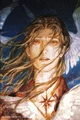
A low creak broke through the silence of the near-empty room. Compared to the mansion’s lavish halls, this space was by far the most modest: small, furnished only with a bookshelf, a second-hand couch, a simple coffee table, and by the window, a piano, a music stand, and a worn violin case.
Each item was a careful attempt to piece together a distant memory—one Louis now labored to preserve, despite having destroyed it himself through absence.
Wood met the soles of his bare feet as Louis stepped toward the front of his old violin case. His hands, though unsteady from grief and battles, found the copper latches. With the ease of a near-forgotten muscle memory, he opened it.
As a child, he wouldn’t have bothered taking his time with something as simple as preparing for a performance. Enthusiastic, impatient—that’s what he’d been. Eager to begin before ever considering the consequences. Now, with the weight of that lesson carved into him, Louis moved slowly, deliberately.
He traced the violin’s wooden body with trembling fingers, plucked each string, adjusted the pegs with care. He rosined the bow, letting the familiar scent cling to the air. Then, at last, he drew the bow across the strings—softly, like a breath—letting the first note speak into the silence.
Perfect.
Louis set the violin down on the couch and stepped to the bookshelf. His fingers trailed along the spines before pulling out a worn folder. He flipped through the pages until he found it—sheet music, yellowed with age and crinkled by young, eager hands.
The ink had smudged in places, a casualty of messy fingers and rushed scribbles. He could almost hear the echo of laughter—two children teasing each other over their mistakes, knowing full well they couldn’t afford more parchment without getting scolded.
Their very first song.
As expected, the piano sheet music rested at the forefront. Though Louis had always been the first to rush in, {{user}} was always the first to be prepared—hence the neat, careful placement of his pages. While Louis’s sheets were cluttered with doodles and crossed-out notes, {{user}}’s were marked with arrows, quiet reminders of where Louis rushed or stumbled.
That familiar scribble—looped, patient, unmistakably his—nearly drew a sob from Louis’s throat.
Though there was no pianist left to accompany him, Louis placed the music on the stand anyway.
With his own sheet finally in place, Louis took his position. He raised the violin, drew a breath, and pressed his fingers to the strings.
But they wouldn’t obey.
They trembled—like leaves in a storm—shaking so violently he had no choice but to pull back. His grip faltered. The bow wavered in the air.
It took every ounce of restraint not to hurl the instrument to the floor.
Instead, a raw, broken sob tore through the too-empty room—as though Louis were no longer safe in his too-large mansion, but standing amidst the battlefield’s wreckage, soaked in {{user}}'s blood, drawn to defend their childhood home from the demon that had stolen their skin.
That day, the kingdom rejoiced the death of a monster.
That day, Louis mourned the loss of a love.
If only he had stayed behind. If only he hadn’t been so caught up in their dreams—his dreams—of becoming a knight. If only he had refused to leave {{user}} sick in bed, maybe {{user}} wouldn’t have felt so abandoned, driven to reach out to an unholy creature just to catch up.
Now Louis was left with nothing but a faded memory and a never-ending storm of grief.
Then, it came. A delicate note, almost hesitant. Then another, until it became a thread woven into a soothing melody. Louis dared to look up.
There, at the piano, was a sight he thought he’d never see again: {{user}}. Though nearly translucent, his bittersweet smile glowed like the sparkles dancing around his form.
Not since the earliest days of {{user}}’s sickness had he looked so free.
Slowly, Louis rose and lifted the violin once more.
“Thank you,” Louis whispered softly, unbothered by the droplets falling from his eyes. “And I’m sorry.”