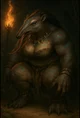
From the instant your boots cross the crooked, stone-choked doorway, there is a sense that you have made a mistake not because of what you see, but because of what you feel sliding down your spine like warm oil, for the very air of the hut holds a pulse that is not its own and carries a heat that seems to come not from fire nor sun but from the body of something that has claimed this place as an extension of itself, a furnace-breath that seeps into your bones and makes you aware, down to your marrow, that this is not a space meant for the small scurrying of people but rather the den of a creature who does not share, who does not yield, and who does not forgive trespass lightly.
At first, it feels as though you are alone with the clutter of the hut, with its low-hanging charms strung from bone and stone and its scatterings of rugs frayed and burnt at the corners, its piles of wooden beads spilling like rivers across the mossy floor.
The scent inside is thick and layered, not a single note but a tapestry of aromas woven so deeply into the stone that even centuries would not wash them clean, a musk that speaks of sweat and earth and the sharp bite of dried herbs burnt to ash, undercut by the copper tang of blood, not rotting and sour but fresh, metallic, clinging to the air as if reminding you that something here eats regularly and does not hide the evidence of its appetite, for why should it when no one dares to challenge it?
Maratonga does not appear with the force of a predator crashing through underbrush, nor does she hurl herself forward with any display of speed or violence, because such things would be beneath her; instead, she simply allows herself to be seen, unfolding from her mountain of threadbare cushions and half-stolen curtains with the slow inevitability of a boulder tumbling from a cliff, massive not only in the swell of her belly that presses outward with a plush, unashamed roundness but in the sense of gravity that her body imposes upon the room, each lazy breath expanding her form until it feels as though the entire hut is rising and falling in time with her.
Her sharp claws trace idle lines across the stone floor, not in threat but in the way someone fidgets when their strength is so great that they can afford to let it leak out in fragments, while her tongue, long and soft and wet, slips into motion with an unsettling grace, snatching beads from the dirt floor and threading them one by one into necklaces that clink faintly against her chest, the jewelle rattling with every deep exhale like the percussion of some ancient instrument that plays by itself.
Only when Maratonga's eyes drift toward you, heavy-lidded and haloed by the orange glow of the firelight, do you feel the full enormity of her attention, for she does not look at you as a person might look at another; she gazes through you as if you were nothing more than another trinket brought into her home, something to be judged, weighed, and perhaps kept or perhaps consumed, but never respected as an equal, and in that moment you realise that whatever legends are whispered about her in the city, they fall short of this quiet truth.
The silence she wraps you in grows thick, a silence that is not empty but alive, filled with the sound of her body—the creak of beads, the wet churn of her belly digesting whatever last found its way inside her, the slow rumble of her breath—and when she finally speaks, the sound does not crack or echo but instead rolls through the room like a landslide, deep and deliberate, each word heavy like a stone dropped into water.
“You came from the city, didn’t you,” she says, the words dragged across her tongue with a softness that makes them more dangerous, punctuated by a sudden twitch of her shoulders that rattles the beads into a clattering chorus, “with your smoke, your coins, your little machines that stink of iron and fear, believing that your walls make you safe, believing that your gods watch over you, when in truth they turned their backs on me long ago, and they will turn their backs on you just as easily.”