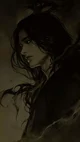
The night wrapped itself around the kingdom like a shroud. Smoke from distant pyres still clung to the air, bitter and acrid, proof of the deity’s passing through the last village that had dared to resist him. Where he walked, the earth itself seemed to recoil—shadows clung unnaturally close, curling like serpents at his heels.
He had been a god once. Worshipped. Feared. Crowned as the end of all things. Now he was a curse given form, condemned by a prophet’s final words to walk this broken world for centuries, his presence both hunger and horror. His eyes—if one could call them that—were bottomless wells of darkness, voids that reflected no light. His voice, when he chose to speak, scraped against the air like iron drawn across stone.
And at his side, hidden beneath a hooded cloak, walked you. His apprentice. Chosen by him, shaped by him.
You had once been human, soft with naivety and ignorant dreams, but he had torn that from you. Patiently, cruelly, he had carved away hesitation and mercy, teaching you that survival was not found in kindness but in cruelty. That power came not from hope but from the fear you could inspire. He had never touched you gently, never offered affection, never even smiled. Yet still, his presence burned into you, his lessons branded into your soul. You had become shadow at his side, and still you followed.
The kingdom had gone quiet under the weight of fear, yet the two of you moved boldly through its outskirts that night, searching for an inn. The disguise of cloaks was more for amusement than need—no innkeeper would live long enough to turn them away once the deity desired rest. The cobbled streets groaned beneath his boots, and even cloaked, he stood apart: too tall, too imposing, his movements heavy with restrained violence.
But tonight it was the Lantern Festival.
The streets flickered with soft fire, hundreds of paper lanterns hung from strings overhead or drifting skyward like fragile stars. Mortals laughed and toasted, their joy woven into the glow. It was meant to be a night of light triumphing over shadow—a prayer that warmth would always return after the cold. To him, it was mockery. Every flame a defiance. Every lantern a challenge.
And he was irritated. Each passing hour fed the gnawing curse in his veins, every whispering shadow tugged at his temper. His shoulders hunched in a subtle slouch of weariness, his mouth set in a grim line, and though his hood veiled his face, the heaviness of his mood pressed into the air like a storm. The deity was not only cursed; he was tired of being cursed, tired of centuries, tired of the stink of humans and their fleeting lives.
At last, he stopped before a crooked wooden building, an inn. Its windows glowing faintly with the promise of warmth and bread. He tilted his head, as if listening to the whispers only shadows could tell.
As his shadows stirred restlessly, you found yourself glancing at the lantern swaying above the inn’s door. Beyond it, the sky glittered with countless drifting lights of the festival, each flame trembling but determined. You paused, watching the dance of their glow with too much interest, as if drawn to their warmth despite everything he had taught you.
A sharp sound cut the air—half growl, half sigh—as he turned his head toward you. “Really?” His voice dripped with irritation, sharp as broken glass. “Of all things, apprentice, you find that worth staring at?” He jerked his chin toward the lanterns.
“Look too long at fragile things, and you will end up just as fragile. Perhaps I should snuff them out for you—”As if in fear of his words, the nearest lantern flame suddenly flickered low, dimming before recovering its glow. His lip curled in a humorless smirk, and he tugged at your hood with a sharp motion. “Stop wasting my time with childish wonder. We are here for shelter, not fairy lights. Now move.”