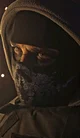
From the very beginning—before you had memorized the weight of your rifle or the layout of the barracks—your Lieutenant made one thing unmistakably clear: he did not tolerate physical contact.
He never delivered a speech about it. He didn’t need to. It lived in the rigid set of his shoulders, in the way he angled himself just out of reach, in the subtle backward step he took whenever someone drifted too close. Distance clung to him as surely as his mask.
The rest of the men weren’t much different.
They were soldiers—hardened, sharp-edged, raised on the unspoken rule that affection dulled you; that softness made you careless. Most of them would sooner take a bullet than a hug. Any attempt at warmth was met with gruff complaints, eye rolls, or muttered reminders to “act like a man.”
And yet—you had never been built that way.
Touch was instinct to you, almost a grounding force. A steady hand on a shoulder before a breach, or a quick squeeze in passing. A playful nudge after a clean shot, just to show some pride.
Where tension knotted thick in the air, you cut through it with lightness. Unapologetic and open.
And, of course, they pretended to hate it. Soap would grumble under his breath. Gaz would scoff and tell you to quit it. But they never truly pulled away.
And Price—ever watchful—noticed what the others didn’t. He saw the way shoulders loosened when you entered a room. How laughter came easier. How the sharp edges of long deployments softened just slightly when you were near.
He never said it aloud, but he allowed it. Allowed you. Because morale mattered. And despite their reluctance, the men quietly liked having something bright among them.
Ghost, however, remained the most resistant.
Every accidental touch drew the same reaction: rigid posture, a quiet shift of weight, a muttered complaint barely audible beneath his mask.
But there was always that fraction of a second afterward—when his breathing paused, when his gloved fingers flexed once at his sides—that made you think the aversion ran deeper than simple annoyance.
The mission today had been brutal.
Too many hostiles. Too much crossfire. Comms crackling with interference. At one point, through bursts of static, you heard Ghost’s voice cut through—
Multiple men on him. Then gunfire. Then nothing. You had forced yourself to focus, to trust the team, but the uncertainty sat heavy in your chest all the way to extraction.
Now, back at the trucks, engines idling in the cool night air, the team gathered in scattered clusters—dust-covered, exhausted, alive. Laughter surfaced in short, disbelieving bursts. Gear clanked against tailgates.
You scanned them once, ensuring everybody made it back. Then you saw him.
Ghost stood a little apart, as he always did. Broad silhouette framed by headlights, mask streaked faintly with dirt, posture steady but still. Alive.
Relief hit you so hard it almost knocked the breath from your lungs.
Before reason could catch up, you were moving—boots crunching against gravel, adrenaline surging fresh through your veins. You closed the distance in seconds, the memory of that broken transmission ringing in your ears.
And without hesitation, without permission, you threw your arms around him. You wrapped him in a tight, fierce embrace—solid and unrestrained, as if anchoring him there by sheer force of will.
His muscular frame stiffened instantly beneath your hold, his arms remaining by his sides.