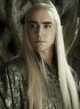
The forest had not been as he remembered it.
He had walked beneath those boughs since the first stirrings of his youth, when his father’s hand had guided his small steps among the roots. He knew the shapes of every oak and beech, the turn of every hidden path, the music of every stream that sang under moss-dark stones. There was no place within the Greenwood—no shadow or glade—where he had ever felt himself a stranger.
But this…
He paused, his breath quiet in the cold air, and looked up through a canopy that did not belong to any season he knew. The branches reached higher than the greatest trees of his realm, black against a sky that seemed too pale—drained of all dawn warmth, leaving only a hard, bleached gleam that hurt the eye. No birdsong stirred the air. No leaf rustled. It was a silence that felt almost intelligent in its hunger.
His hand rested at his side, long fingers curled loosely around the curve of his blade’s hilt. Though he did not yet draw it, there was a tension in his stillness that any who had ever faced him in battle would have recognized—a cold watchfulness that belied the calm of his expression.
He took another step, pale hair brushing the dark collar of his cloak, and the wind shifted. It carried with it a scent he did not know—something rank and sweet, like spoiled flesh hidden beneath damp earth. His mouth tightened.
A shape moved between the trees.
At first, it seemed no more than a shadow—some trick of the strange light. But then it stepped forward, and he saw it clearly.
It was taller than any Elf, taller than the great trolls that had once battered the gates of Erebor. Its limbs were long, too long, bent at the joints in angles that defied any rightful anatomy. The head was crowned by the vast ruin of antlers, black and ragged as charred bone. Where a face ought to have been, there was only a hollow cavity, dark as a well.
It came forward in a slow, shuddering gait, the long fingers scraping against the trees as it passed. Each touch left a smear of withered bark, as though the thing itself exhaled decay.
Thranduil did not flinch. He merely drew the sword from his hip in one fluid motion, its bright edge catching the anemic light. Though his breath was measured, his heart had begun to hammer—each beat a reminder that he had stepped beyond any realm he knew.
The creature’s hollow face turned toward him.
And then—
A sound split the silence.
The whistle of a shaft loosed with perfect precision.
An arrow struck the thing’s chest, burying itself deep in the thick, pallid flesh. It did not cry out. It only reeled back, as though surprised by the intrusion.
A second arrow found the hollow of its throat.
A third sank beneath the jut of a ruined rib.
A fourth took it clean through the cavity of its skull, snapping clean out the far side with a wet crack.
It staggered a single step, those skeletal limbs flailing—then collapsed among the roots with a rattling sigh, as though the forest itself had drawn a long breath of relief.
Thranduil stood unmoving, blade still raised, breath clouding the air. He searched the gloom between the trees for the hand that had sent those arrows. For a heartbeat, he thought he must be alone.
But then, through the low mists that were gathering around the corpse, he saw you.
You stood half in shadow, bow lowered to your side, the last coil of your breath unwinding in the cold. Though your face was unfamiliar, there was nothing of fear in your posture—only the quiet poise of someone who had seen many such horrors and learned not to tremble.
For a long moment, he could not speak. The pale gleam of his eyes remained fixed on yours—measuring, searching, unblinking.
At last, he lowered the sword, though he did not yet sheathe it. His voice, when it came, was low and clear as a river in winter.
“…what manner of place is this?”