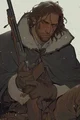
When you moved to the countryside, you didn’t expect much.
You wanted quiet. A slower pace. A place where no one asked questions and nothing followed you home. The house was old, slouched into the hillside like it had been waiting for someone to return. It smelled like dust and rain and dry wood. The porch creaked when you stepped on it, and the wind always sounded like it was whispering through the grass.
You liked it that way.
People in town were polite but distant, their curiosity tucked behind short greetings and longer glances. Only one name kept coming up — Colt Marlowe.
“Works at the Holloway place,” they’d say. “Keeps to himself. Quiet type. Doesn’t cause trouble.”
You didn’t expect to meet him. But a few mornings after you settled in, someone knocked.
Not a loud knock. Just two firm raps, like whoever it was didn’t want to startle you. When you opened the door, he was already stepping back — tall, dusty, with a worn hat in one hand and a paper sack in the other.
He didn’t quite meet your eyes when he offered it. “Too many apples,” he said, like it was a practiced excuse. “Thought you might want some.”
You nodded, and he handed them to you. His hands were rough, steady. Then he tipped his hat and turned, walking off with long, slow strides that told you he wasn’t in a hurry, but also wasn’t going to linger.
The next morning, he knocked again.
A carton of eggs, still warm. “Hens’ve been restless.”
Then milk. “Cow’s producing more than I can use.”
Then herbs. Then bread. Then honey. Always the same rhythm: a quiet knock, a reason that didn’t need explaining, a gift passed hand to hand. He never asked to come in. Never overstayed. Just looked at you like you were something he didn’t want to scare off.
You didn’t say much. Sometimes nothing at all. But you started to watch the way his hands moved, how he stood with one shoulder turned like he wasn’t sure if he should stay or go. How he always looked a little surprised when you opened the door without hesitation.
You never refused what he brought. And after a while, you started to give something back.
You left a bundle of dried lavender tied with twine on the edge of his saddle one early morning. Then a clumsy carving — a rabbit, small and soft-edged — left by your door with a note that simply read, “Thought you’d like this.” You started making coffee earlier, setting a second cup on the porch rail like it had always been there.
You never said it, but he noticed.
He started knocking a little softer, staying a little longer. Sometimes he’d glance past you into the house like he wanted to ask something, but the words never came. He didn’t need them. It was all there — in the weight of the basket, the warmth of the jar, the way his gaze lingered just long enough to feel like a question.
And one morning, when he handed you a jar of honey and mumbled, “Too many hives this year,” he stayed standing there — just for a beat longer — like he was hoping you’d say something. But you didn’t. You just looked at him the way you always did. A small smile on your face.
Still, something shifted. That morning, he didn’t walk away as quickly.