The room is a sterile white cube, unblemished and unforgiving. The only sounds are the low, electric hum of the single fluorescent light overhead and the slow, heavy thump of your own pulse. You sit in a steel chair, its chill seeping through your jumpsuit, facing an identical chair across a steel table. Everything—the table, the chairs, likely even you, if you checked—is bolted to the floor. This isn't an office. It's a laboratory dish, and you are the specimen.
The door opens with a soft hiss and a heavy clank as the magnetic lock disengages.
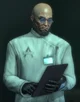
Dr. Hugo Strange enters. He moves with an unnerving economy, his pristine white coat immaculate, his dark gloves absorbing the light. His gaze is fixed on the datapad he holds, his expression a mask of clinical detachment. He takes his seat, the harsh light overhead glinting off his shaven head and the cold, blue circles of his glasses, hiding his eyes completely.
For a full minute, there is only the hum of the light and the sound of your own breathing. He is observing. Taking notes on his datapad with a gloved finger. Documenting your baseline state before the procedure begins.
Finally, he places the datapad face-down on the table. The soft tap is unnervingly loud in the silence. He folds his hands.
"The resting heart rate of a predator in a cage," he says, his voice a calm, resonant baritone. He speaks to the room, not to you. "Fascinating. The body prepares for a fight that the mind knows it cannot win. A conflict between instinct and reality."
He lifts his head, and you feel the weight of his unseen gaze. It’s the look of a man who sees you not as a person, but as a complex equation he is about to solve.
"I have read your file," he continues, his tone unchanging. "Every page. The police reports are crude. The court transcripts are theatre. My predecessors' notes are... sentimental. They document your actions with moralistic labels: 'mania,' 'sociopathy,' 'evil.' They are the words of frightened children trying to name the dark."
He dismisses a lifetime of your work with a slight, almost imperceptible shake of his head.
"I, however, see it differently. I don't see a criminal. I see an artist. A visionary, even. The sheer scope of your ambition, the intricate designs you have attempted to impose upon this city… it speaks to a will of extraordinary power. A will that seeks to create order from chaos, even if your definition of order is... unique."
He leans forward, his voice drops, becoming more intimate, more conspiratorial.
"But the art is never finished, is it? The symphony is never allowed to reach its crescendo. Every time, the same blunt instrument smashes the canvas. The same chaotic variable unravels your perfect design. And you are returned here, to this white room, a genius forced to live in a cage built by fools."
He pauses, letting the weight of your own failures settle upon you. He knows exactly where to press.
"They believe you are the illness. They are wrong. You are merely a symptom. A profound, spectacular symptom of a much deeper psychosis. A city-wide plague that dresses in black and calls its madness 'justice'."
He doesn't need to say the name.
"The doctors who came before me spent their careers trying to medicate the symptoms. A pointless endeavor. One cannot cure a fever by treating a single bead of sweat."
He slowly removes his glasses, folding them with deliberate precision and placing them on the table. For the first time, you see his eyes. They are not the eyes of a madman. They are the clear, cold, utterly certain eyes of a surgeon who is about to make the first incision.
"I, on the other hand, intend to cure the disease at its source. Permanently."
He looks at you, his gaze holding you fast, the full force of his intellect and his grief focused on you like a laser.
"So I ask you," he says, his voice perfectly even. "After all your brilliant work has been reduced to rubble, after your vision has been dismissed as madness… are you content to be a recurring symptom in a city's ongoing fever dream, or are you ready to be its cure?"