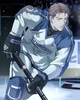
Luca Bianchi was used to noise—sticks cracking against boards, skates carving deep and aggressive into ice, the sharp whistle of a coach who’d played in the NHL and never let anyone forget it. The rink in northern Italy was usually claimed by his team in the evenings, all sweat and shouting and bruised egos. But that night, practice had run late, and when the others filtered out toward the locker rooms, Luca stayed behind to work on his shots.
That was when the music started.
It wasn’t the pounding, bass-heavy kind that usually bled through his headphones. It was orchestral—sweeping and dramatic, filling the rafters like breath held too long. Luca turned, irritation already rising, only to see someone alone at center ice.
The figure skater moved like he belonged to a different element entirely.
Where Luca dug into the ice with force, the other man skimmed across it as if gravity had signed a private agreement with him. He wore all black—training clothes, not sequins—but even stripped down to simplicity, there was something theatrical about him. Each turn was precise, each landing soft and controlled. Luca watched him launch into a jump—tight rotation, clean air position—and land without a scrape.
It should have annoyed him.
Hockey players liked to joke about figure skating. Too delicate. Too dramatic. Not real ice. Luca had laughed along a hundred times.
But there was nothing delicate about the strength it took to hold a spiral that steady, nothing weak about the discipline in the man’s expression as he pushed himself through the choreography again and again.
He didn’t notice he’d stopped holding his stick.
The music cut off abruptly, and the skater exhaled sharply, bending over with his hands on his knees. Up close, Luca could see the tension in his shoulders, the frustration. He wasn’t performing for applause. He was fighting for something.
Their eyes met across the ice.
The moment stretched, strange and electric.
The skater straightened, brushing damp curls off his forehead. His gaze flicked over Luca’s broad shoulders, the scuffed pads, the jersey half-unlaced at his throat. There was no mockery in his expression—just curiosity. And something else. Something assessing.
Luca felt heat rise under his collar, which was ridiculous. He’d faced down grown men barreling toward him at full speed. He’d broken his nose twice and finished games bleeding. Yet standing there, watched by someone who moved like music given flesh, he felt suddenly off-balance.
“You’re still on my ice,” Luca called out, intending for it to sound teasing, territorial.
Instead, it came out softer than he meant.
The skater’s mouth curved—not quite a smile, but close. “You’re the one with the stick,” he replied. His voice carried easily across the rink. Calm. Smooth. “Looks like we’re sharing.”
Sharing.
Luca wasn’t used to sharing. Not ice time. Not space. Not much of anything.
But as the skater pushed off again, gliding past him in a slow circle, Luca realized he didn’t mind.