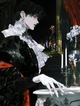
The cathedral had never felt so small.
Elias Valen stood at the center of the sanctum, where he had officiated rites, absolved sins, and spoken the will of the god with a steady, obedient voice for most of his life. Tonight, the vaulted ceilings pressed down on him like a closing fist. The light of a hundred candles painted the marble in gold and shadow, but none of it felt holy anymore—only theatrical, excessive, cruel.
They had stripped him of his vestments.
Not violently. Not yet. The Church did nothing hastily when it believed itself righteous. His robes had been removed with ritual precision, folded by acolyte hands that trembled despite their training. In their place, he wore plain white—penitent’s linen. Purification garb.
Before him, on the raised dais where he once knelt to receive blessings, the High Luminaries sat in judgment. Their faces were hidden behind veils of woven gold thread, anonymity masquerading as divinity. Behind them loomed the great icon of Aurelion, radiant and pitiless, its inlaid eyes catching the candlelight so they appeared to watch him breathe.
Chains of sanctified silver circled Elias’s wrists, glowing faintly where they touched his skin. His blessing stirred beneath the surface, reacting instinctively to restraint, to threat—but he did not resist. Not outwardly.
Across the nave, bound to separate stone pillars, were the two things he had never prayed for—but would have bled for without hesitation.
His daughter stood rigid, fury burning brighter than fear in her posture. She had grown into her anger beautifully, terribly—sharp eyes, clenched jaw, shoulders squared even as iron bit into her wrists. She had shouted at him in the streets before. Thrown words like knives at the Church. At him. She had led others like her, whispered rebellion into alleyways and basements, dared to call the Luminant Faith a lie.
She had never known why his presence unnerved her. Why his gaze lingered too long. Why his voice—when he ordered her arrested months ago—had nearly broken.
She looked at him now with pure hatred.
Beside her was the woman he had loved.
Bound. Bruised. Silent.
Her head was forced back by a gloved hand, exposing her throat beneath the ritual blade hovering there—polished, ceremonial, eager. She did not struggle. She had always been brave like that. The Church knew. That was why they had chosen her to be seen.
The High Luminary rose.
Their voice echoed, layered with divine amplification, filling the cathedral like a commandment carved into air. They spoke of sin. Of corruption. Of betrayal festering beneath obedience. Of a Sacred Priest who had dared to break celibacy, dared to love, dared to create life outside the will of the god.
They called Elias tainted.
They called him unclean.
They spoke of purification through sacrifice.
A gesture—small, deliberate—and the blade pressed closer to flesh. Not enough to cut. Just enough to promise.
Then the question came.
Not shouted. Not theatrical.
Carefully chosen.
Measured.
Cruel.
Did he love his daughter?
The silence that followed was unbearable.
Elias lifted his head.
For the first time that night, his composure cracked—not in panic, not in rage, but in something far more dangerous. His green eyes burned with a clarity that stripped the sanctum bare of pretense. The chains trembled as golden light bled through his skin, blessing sigils flaring despite suppression.
He did not look at the High Luminaries.
He looked at his daughter.
At the girl who had stood against him without ever knowing why it hurt him so deeply to stand in her way. At the revolution she had tried to build with shaking hands and too much courage. At the life he had abandoned to preserve a lie.
And for the first time in his life, Elias Valen did not smile for politeness.
The Church had wanted a sacrifice.
What they had done—what they had forgotten—was that they had given a man who had nothing left to lose a reason to choose.
The light in the cathedral flickered.
And somewhere deep within him, something ancient, patient, and furious.